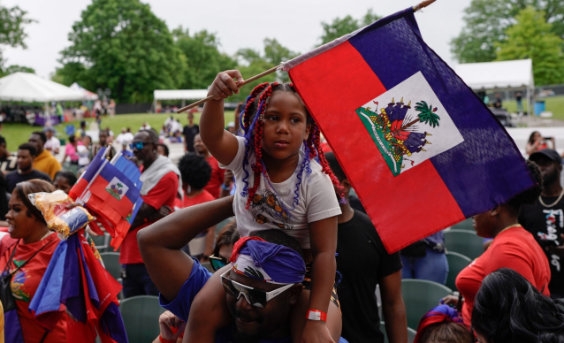
It is becoming clearer by the minute that crisis-hit Haiti has become the global pariah, a reproach, and a bane to its neighbours.
Haiti’s most celebrated and prosperous neighbour, the United States, is located to its west, less than 2000 miles from its most western tip. The giant-sized US economy, puffed up with pride in its commercial prosperity, takes pleasure in shooing away hungry and hankering Haitians from its shores.
Despite a treaty signed in 1915, guaranteeing United States’ protection, Haiti has no assurance of help from President Trump nor his allies, including Jamaica. It is no surprise that Haiti was one of only two Caribbean nations that appeared on the travel restrictions list recently issued by US president Donald Trump.
How a nation chooses to spend its money, where it goes to spend it, or who it handpicks as the beneficiaries of its largess is really nobody’s business. US foreign assistance supports a wide variety of humanitarian, economic development, and democracy-promotion efforts, although the categories can be somewhat opaque and the lines between them blurry.
The US determines to offer financial help to another country based on its own best interests and for its own global good. Haiti appears to be of little interest and amounts to less than a modicum of good to the United States.
Unlike Haiti, the US’s interest in Ukraine, which is on the other side of the pond, appears to be humongous. That country has been provided with over $182.8 billion in emergency funding since the beginning of the Russian invasion in February 2022. This includes military, financial, and humanitarian assistance.
However, since the 2010 earthquake in Haiti, the US has made available over $5.1 billion for assistance to its immediate neighbour in post-disaster relief as well as longer-term recovery, reconstruction, and development programmes.
In 2023, the most recent fiscal year for which data is largely complete, the US government disbursed $71.9 billion in foreign aid globally. Less than one percent of this amount was made available to food-starved Haiti. In fact, between 2021 and 2024, the US granted Haiti $1.1 billion in humanitarian assistance. This included funding for food security, WASH (water, sanitation, and hygiene), and health.
Despite the advocacy of its Caribbean neighbours for increased international help for Haiti, not much has been gained. CARICOM says it continues to actively seek greater international support for security and humanitarian relief for the strife-torn state.
Even before the ravages of the earthquake in 2010, Haiti had been on a long-term all-out war against poverty, political upheavals, and gangsterism. It has a litany of trials and perhaps a few indistinguishable triumphs. One of the most downplayed of its trials is its deep cultural and occultic underpinnings that keep the masses locked into a spiral of iniquitous rituals that have produced devastating outcomes.
Haiti has many churches, and enough Christians are there to break and boot the cursed crises. In fact, a single Christian, walking righteously, under the leading of the Holy Ghost, can change the very trajectory of that country, as the people who know their God are strong and can do great exploits.
But, since the signing of the 110-year-old US protection agreement, Haiti continues to see the decimation of its population through prolonged seasons of woes, and their troubles have now overflowed into other neighbouring countries.
Like a byword to other nations, Haitians running from the perils of life on their own soil, landing on any mainland in the region, including the mass they share with the Dominican Republic, spark a calamity that is tantamount to the bubonic plague. At the sight of a raggedy boat meandering offshore with hungry black faces, every Caribbean government prepares for battle, calling out armies and hastily shoving the fleeing Haitians back to the solitary confinement of their homeland.
In just under 24 hours after arriving on the Portland shores of Jamaica a few weeks ago, 48 more Haitians were rushed aboard a Jamaica Defence Force Coast Guard vessel and freight-forwarded back to their country.
United Nations experts have been warning that Haitian women seeking pregnancy and postpartum medical care in the Dominican Republic, their immediate neighbour, were reportedly being arrested during check-ups and deported to danger without a chance to appeal.
This is in contrast with the global response to Ukrainians and white South African farmers seeking refuge on this side of the world. While countries call out armies to block desperate Haitians, when it comes to others, they roll out the red carpet and reach for the well-preserved pages of the United Nations Refugee Convention of 1951 to justify a right humanitarian response.
Haiti is in deep crisis, but the racial make-up of the majority of the population seems to have significantly worsened their plight and drastically influenced their outcome.
Reaching for the race card in search of a reasonable explanation of the starkly unjust responses to Haitians is heartbreaking but necessary. The general context of the ill-treatment of people of African descent is real across the globe and looms larger than life in too many instances.
Jamaica, Dominican Republic, and other nations in the region might have been omitted from Trump’s travel restriction list this time, but they can be sure of this: should the unfortunate fate of Haiti befall any of them, foreign friends, including Trump, would fast become foes.
No country, especially Trump’s United States, would lavish them with gifts, grants, visitors, or visas.
Haiti may be a real-time, regional example of reproach now, and the hardline taken by Haiti’s immediate neighbours, including the US, Jamaica, and the Dominican Republic, is of no help to the embattled state.
If only the Haitian people would stand together and reject wickedness, pray, and seek God’s face, He would hear from heaven and heal their land.
Pray for Haiti.