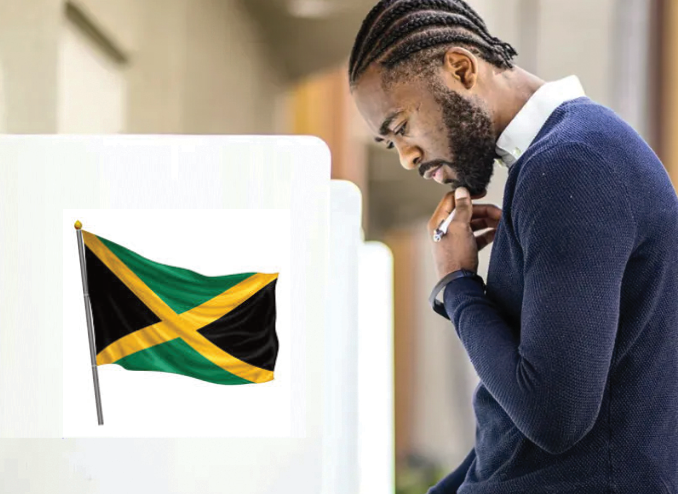
It is reasonable to assume that the Christian community featured heavily among the many electors who stayed away from polling booths in the last General Election.
Just over 37% of eligible electors cast a vote then, while a whopping 63% of those who registered to vote did not bother to exercise their franchise.
For many Christians, the church has no business with politics. In fact, believers in Christ often face heavy criticism, especially on social media, whenever they express views on the politics of the day, the government, or how it governs.
For eons, the church has been told that it must remain silent on matters of the state and for eons it has fallen for the wicked lie, allowing those who reject God, in the main, to opine and rule.
The concept of separation of church and state is used as a gag order, shutting down the Christian voice whenever it attempts to enter the public square.
In Jamaica, the majority of the population identifies as Christian, with figures at around 69% in the most recent census. Therefore, some 1,863,000 of the 2.7 million population claim to be Christian.
Essentially, if Christians were to follow the advice of the wicked and walk wide, hold their corner, and keep their distance away from participation in politics, it would be a cruel case of the minority determining public policies and forcing the majority to comply with them.
By silencing the majority, the way is clear for those who want to advance secularism, engage in corruption, freely feather their nests, and enrich themselves and their friends to do so without objection and righteous resistance.
The idea of keeping the right hand of God at bay is rooted in the principle called the “wall of separation” that Thomas Jefferson described in an 1802 letter to the Danbury Baptist Association.
This controversial ‘wall’ was built around Jesus’ statement, that citizens must ‘…render to Caesar the things that are Caesar’s, and to God the things that are God’s.’
This verse is used to justify the notion that God has His distinct sphere of authority and influence, which is separate and different from that of the state. It rejects the fact that God establishes and removes governments at His will. It downplays the notion that both church and state must synchronise in a manner that brings glory to God, who has the power to bless, prosper, or demolish nations.
The truth is, except the Lord builds the nation, they labour in vain that built it.
In Jamaica, the church and government seldom meet, except for ceremonial occasions. On the fringes of society, the church appears to be nominal, powerless, and gingerly pointing out obvious offences, infractions, and indiscipline in leadership and among the wider populace.
Weakened as they appear to be, churches still play a multifaceted role in any society, encompassing spiritual, social, and even political spheres. Members provide spiritual guidance and education from the early childhood to tertiary level, formally and informally.
For centuries, the church also serves as a source of social services, promoter of family values, community builder, and significant force in healthcare, supporting the sick and the lame, the elderly, and the youth.
Despite incidents when elements of the body fail and fall into compromise, the church has continued to be a living, breathing moral compass and check-point for integrity, honour, and decency, for the most part.
Christians must understand that the Bible does not dodge politics; it addresses it frontally. It provides graphic perspectives on the role of government and its relationship to God. Scriptures acknowledge the existence and authority of governing bodies, emphasising obedience to them as ordained by God, while also highlighting the higher allegiance believers, especially those in leadership, owe to the Sovereign Lord.
There are many examples in Scriptures of how nations prospered when the king followed the ordinances of God, and how they were defeated and destroyed when kings went astray.
Politics in Europe and the Americas is heavily influenced by Christianity. Evangelical Christianity, especially, has informed many political views on social issues, such as abortion, homosexuality, and public education from passages in both the Old Testament and the New Testament.
In Jamaica, groups like the Jamaica Coalition for a Healthy Society, Lawyers Christian Fellowship, and Love March Movement have stood firmly against unrighteous agendas edging their way into societal acceptance.
If Jamaica is to truly flourish and play her part in advancing the welfare of the whole human race, it must be led by righteous men and women who are rock solid on integrity and who are determined to shape and nurture the nation according to righteous standards.
A nation’s moral character is key to its elevation and prosperity. If that character is about righteousness, that nation will enjoy prosperity. If it is based on sinfulness, it will lead to its downfall. When righteous men and women occupy the high seat of government, justice, truth, and prosperity are natural outflows.
While it is true that church membership has seen major decline over the years, so too has participation in the electoral process.
The Christian community must come to terms with the fact that within the church resides real power to demand righteousness from those who offer themselves to govern.
Of those Christians who will vote in the upcoming polls, some will join party lines, but the troubling issues of integrity, the LGBTQI push, abortion rights, NIDS, and rampant secularism will inform the decisions of many.
There is power in the Christian vote.