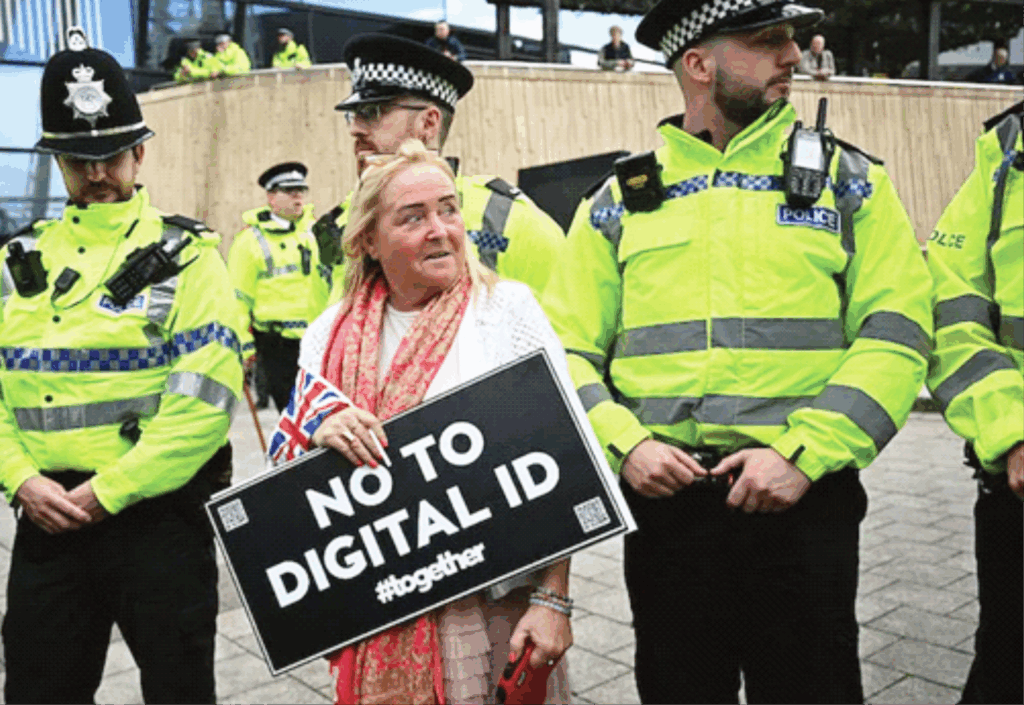
Over recent weeks, anti-immigrant protests escalated across Europe, from the Hague to London, Northern Ireland, and Poland. People took to the streets, unleashing their political anger and fears about a “looming flood of outsiders.” Strong positions against immigrants also intensified in the United States since the last presidential elections.
Simultaneously, the demand for a global digital form of identification has increased, fueled by the desire to stop immigrants from crossing borders, moving money, or even boarding airplanes.
The United Nations has been the primary driver of this idea, promoting it as the ultimate remedy to quell global fears and calm economic jitters. The biometric identification system is expected to track the movements of men by DNA, dollars, and devices. Those who are pushing this beast ideology argue that the system will broaden economic participation, provide greater convenience for transactions, enhance security, and achieve world peace.
This digital biometric identification network is the worldwide track on which the central control of humanity will run. Its promoters are determined to convince every individual on the face of the earth to hand over their freedoms to entities they do not know or trust, by signing up for a unique number that is not replicated by anyone else in any other country in the world.
This unique number will be the traceable mechanism for identification, replacing the need for birth certificates, passports, and every other form of identification. The unique number assigned to each individual will supersede even a person’s name as a foolproof form of identity.
This delusive idea of the UN, World Economic Forum, and others has had its starts and stops, as governments try to encourage resistant populations to get on board.
For Jamaica’s part, the National Identification System (NIDS) will join the international interface, keeping right in step with the beast agenda for centralised control of all humanity.
In 2017, former General Manager, Caribbean Country Department, Inter-American Development Bank (IDB), Therese Turner-Jones, told a press conference that the National Identification System (NIDS) will lay the foundation for Jamaica to become a digital economy. The digital economy is the worldwide network of economic activities, commercial transactions, and professional interactions that are enabled by information and communications technology.
Estonia surged ahead and introduced its mandatory digital ID system in 2002, and people use it to access medical records, for voting, banking, and digital signatures. Australia and Denmark also went for digital ID apps that people download and use to log into government and private services.
These systems have all experienced high levels of fraud and other complaints.
In 2009, India introduced its Aadhaar platform, a biometric-backed identity system that encountered major setbacks as the population complained about privacy and the potential for surveillance. Many marginalised groups were excluded as they were unable to access or use the technology. The system was also hit by high levels of fraud, such as synthetic identity scams and fraudulent Aadhaar modifications.
Last week, Sir Keir Starmer, Prime Minister of the United Kingdom, hinted at plans to introduce a compulsory UK-wide digital ID scheme. Starmer said the new ID would help crack down on illegal employment and modernise the country. Beyond Starmer’s grand announcement, plans to use this new ID scheme to check people’s right to live and work in the UK have emerged. This has excited many UK ministers of government who see digital identification as the cure-all to tackle illegal migration.
Open Rights Group, a civil liberties campaign, said the government’s proposals risked creating a “pre-crime state where we constantly have to prove who we are as we go about our daily lives.”
Digital IDs are expected to manage immigration and money, as well as facilitate the world’s version of peace and stability. Peace, according to world standards, means tolerance of multiple religions, cultures, lifestyles, and practices that are detestable to God.
Know this: when the world says ‘peace and safety,’ we all should anticipate sudden destruction. God will not be mocked.
Leaders of governments and global authorities will enforce legislation to silence opposing voices, especially the Church, and stamp out pockets of resistance. Even some who claim to be Christians will demand tolerance of unrighteous lifestyles for the sake of world peace. There will be calls for compromise as lives, jobs, and communities will face enormous threats. The levels of wickedness and the determination of ungodly enforcers will be so intense that even close family members will become fearful and choose the easy way out. Some will cave in and join the agents of Satan against their own relatives who put up resistance.
Christians who are determined to stand for the truth of God must brace for devastating persecution, face adversarial courts of law, and inhumane imprisonment. The promise of God is that when these things happen, He will shield His people. His sure protection will come even when the harshest courts present seemingly undeniable charges. He will provide a solid and irrefutable defence to every accusation.
Countries that will refuse the global peace solutions in the end times will suffer severe sanctions. Only God-led nations and political leaders, who are committed to righteousness, will resist the ungodly digital leash and stand firmly against the massive push, coercion, and allure of the beast.
The Jamaican government foolishly believes it has spared the nation from what is to come by siding with ungodly international bodies, following their dictates, falling in line with the one-world order, and joining the global digital identification parade.
We must repent and turn away from this wickedness, immediately!