
Dear Editor,
President Donald Trump announced on Saturday, February 28, that the iconic supreme leader of Iran, Ayatollah Ali Khamenei, was killed in a joint US-Israel targeted bomb attack. According to CBS News, approximately forty Iranian officials were also killed in the same attack.
With not just the ultimate leader being killed but several others of the current regime, will Iran’s governing structure hold firm? President Trump has encouraged the Iranian people to topple the current government. What could a new government mean for religious liberty in Iran?
The United Nations (UN) recognises religious liberty as a fundamental human right. Article 18 of the Universal Declaration of Human Rights (UDHR) says this:
“Everyone has the right to freedom of thought, conscience and religion; this right includes freedom to change his religion or belief, and freedom, either alone or in community with others and in public or private, to manifest his religion or belief in teaching, practice, worship and observance.”
A Historical Snippet of Leadership in Iran
Iran, formerly the biblically referenced Persia, has an approximate population of 92.5 million, with 99% being Muslims. The autocratic Pahlavi monarchy was overthrown in February 1979 when Ayatollah Khomeini returned from exile to lead the revolution. When Khomeini died in 1989, Ayatollah Ali Khamenei became the country’s supreme leader and occupied that role until his February 28th, 2026, death. Ayatollah is really a title, and the holder is recognised as one with expert knowledge of Islamic jurisprudence, philosophy and Quranic wisdom. They are often relied on regarding the interpretation of the Islamic religious law.
While the Pahlavi monarchy embraced Western systems, including being receptive to the religious liberty of minority religious groups (such as Zoroastrians, Christians, Jews, and Bahais), things were far from lax when Khomeini took over in 1979. As Khomeini took control in 1979, a referendum was run, approving Iran becoming an Islamic Republic and, particularly, a proponent of Shia Islamism.
The principles of Shia Islamism see the marrying of Islam, as a religion, with a political and social system – three in one. No separation of church and state. Further, the nation’s religious leader (who is automatically the political leader) must be a descendant of Ali or have reached the occultation of the 12th Imam. Khamenei is accepted to be a descendant of Ali. Ali was a cousin and son-in-law of the Prophet Mohammed. In Shia Islamism, Ali, revered for his knowledge and courage, is seen as a rightful successor to Prophet Mohammed.
Legislation Against Religious Liberty and Religious Persecution of Non-Shia Muslims
Iran, under the Ayatollah regime, saw the harsh and violent stifling of religious liberty. This approach to religious freedom is supported by Iran’s Constitution as well as the legislation of the Islamic Penal Code. Article 12 of Iran’s Constitution establishes that Islam, and in particular, Shia Islam, is the official religion of Iran.
Article 13 says: “Zoroastrian, Jewish, and Christian Iranians are the only recognized religious minorities, who, within the limits of the law, are free to perform their religious rites and ceremonies, and to act according to their own canon in matters of personal affairs and religious education.”
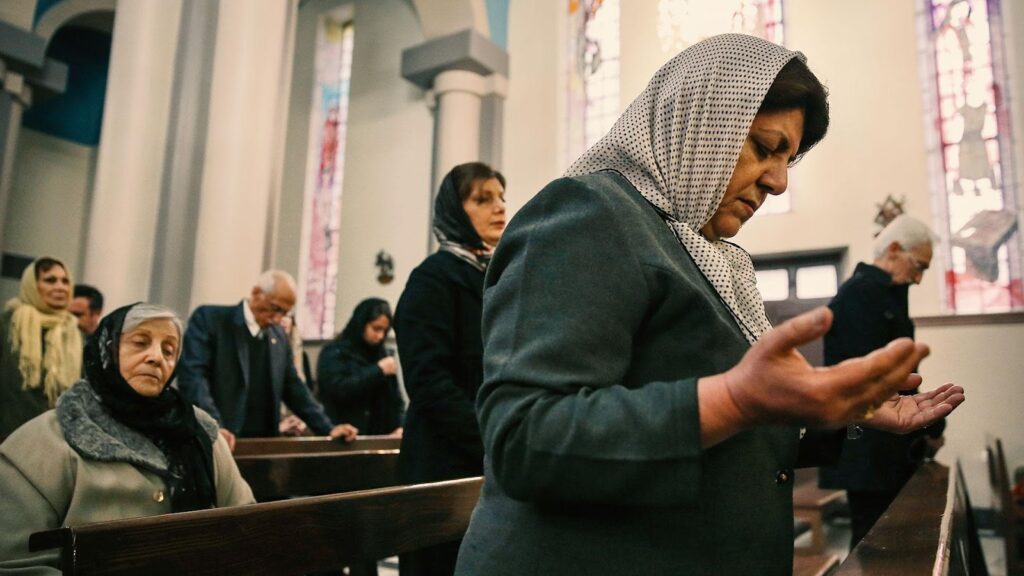
Thus, for those who practise Baha’i, Sufi and Sunni Muslims, Mandaeans & Yarsanis, and others, their faith is not recognised, and the practitioners of these various minor religions encounter persecution. The persecution may translate in several ways. Given the non-acknowledgement of them exercising the rites of their religion, members of these faiths have no legal standing to set up religious or educational establishments.
According to Article 500 of Iran’s Penal Code, individuals (such as those outside the recognised religions) who execute “any deviant educational or proselytising activity that contradicts or interferes with the sacred law of Islam” will face a fine or a 2-5 year imprisonment. Whippings and long prison sentences, as well as executions, may also result from breaching religious positions in Iran’s Constitution and Penal Code.
A pertinent point to note is that, while Christianity, Zoroastrianism and Judaism are recognised under Iran’s law as minor religions, evangelising is not allowed, and proponents of these religions, if caught proselytising, can also be prosecuted under Article 500 of Iran’s Penal Code. In other words, non-Shia Islamists, who are the recognised minor religions, are only allowed to practise their beliefs, but Christians, for example, are not permitted to execute Jesus’ St Matthew 28 vs 19 mandate of making disciples of all men. In 2025, Human Rights Watch reported that 96 converts to Christianity, in 2024, were sentenced to a total of 263 years in prison. The truth is, while the law on apostasy (especially Shia Muslims converting to another religion), in Iran, is silent, Article 167 of Iran’s Constitution, empower and mandate judges to still make a ruling.
The US Commission on International Religious Freedom, in buttressing the position of Iran being a weak religious liberty environment, states that the Shia-Islamic government indulges in “systematic, ongoing, and egregious violations of religious freedom, including prolonged detention, torture, and executions based primarily or entirely upon the religion of the accused.”
Iran and International Human Rights Law
Whether or not the current Ayatollah regime changes, Iran should really look to honour requirements of international law as per its June, 1975 ratification of the ICCPR. Article 18(1) & 18(2) of ICCPR say this, respectively:
1. Everyone shall have the right to freedom of thought, conscience and religion. This right shall include freedom to have or to adopt a religion or belief of his choice, and freedom, either individually or in community with others and in public or private, to manifest his religion or belief in worship, observance, practice and teaching.
2. No one shall be subject to coercion which would impair his freedom to have or to adopt a religion or belief of his choice.
Article 19 of ICCPR advocates for freedom of thought, expression and belief. Further, equality of all individuals and the fact that discrimination should not be allowed are reflected in Articles 2, 26 and 27, respectively. Additionally, Article 20 of the ICCPR also speaks to discrimination, registering that states have a responsibility to disallow religious hatred which incites discrimination and violence.
What will happen, and who will lead Iran? Reza Pahlavi, prince and son of the 1979 ousted monarch, has prominently voiced his interest in leading the country. Sixty-five-year-old Reza, who did an interview with 60 Minutes on Sunday, March 1, after Khamenei’s death, has expressed some positions which would be attractive to religious liberty watchers. Prince Pahlavi says that if he is afforded the opportunity to lead the country, one of the fundamental things he would do would be to separate the church from the state. At the same time, for a while now, there has been huge speculation in Western media that Ayatollah Khamenei’s son, Mojtaba Khamenei, has been groomed as his successor. If Mojtaba gets to lead, it is unlikely that, at this time, Iran will see any improvement in the scope of its religious liberty.
I am,
Garfield Goulbourne