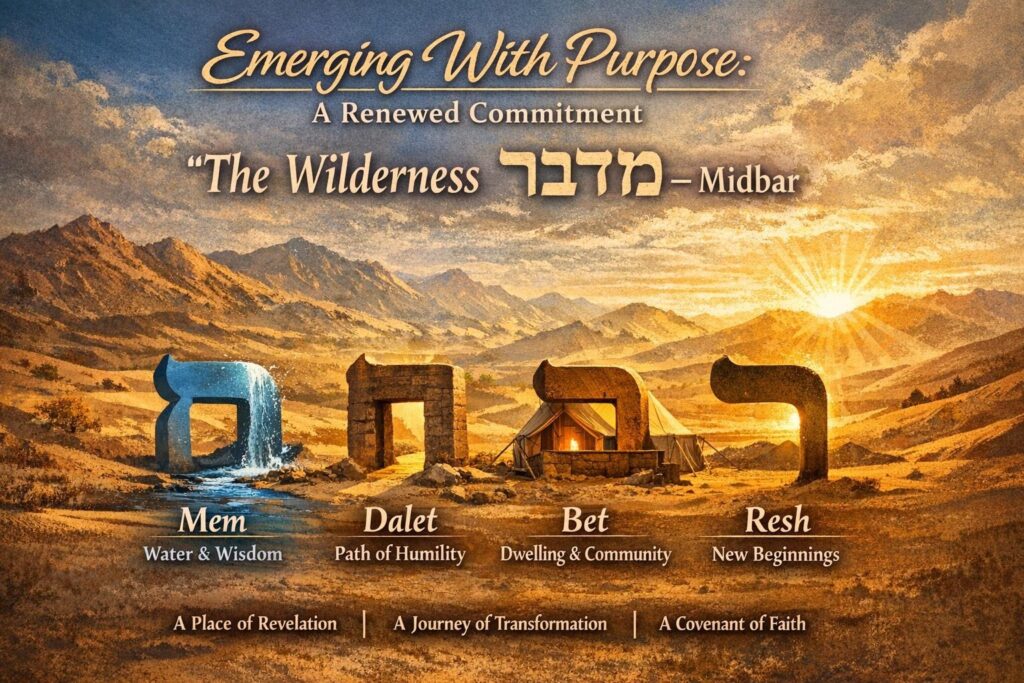
The Hebrew word for wilderness is מִדְבָּר — midbar.
It is often translated simply as “desert”, yet in Jewish thought the meaning is far richer. The wilderness is not merely empty land. It is the place of formation, testing, and divine encounter — the place where Israel received the Torah and became a people.
Let’s take a deeper look at midbar—it comes from the root ד־ב־ר (D-B-R), the same root that gives us “davar”—word, matter, or thing—and “daber”—to speak. Rabbinic teachers have long noticed this connection: the wilderness shares its root with speech. The implication is profound. The desert is where distractions are stripped away so the voice of God can be heard clearly.
Even the letters of the word tell a story. The first letter, mem, carries the idea of water—the symbol of wisdom and Torah. Jewish tradition says, “There is no water except Torah.” The wilderness therefore becomes the place where divine wisdom flows. The next letter, dalet, represents a door but is also linked with poverty and humility. Revelation requires emptiness; one must become humble enough to receive instruction. The third letter, bet, means house — the building of a people and a covenant community. Finally, resh signifies headship and beginning, the formation of leadership and destiny. Put together, the word suggests that through humility, divine instruction forms a people and prepares them for leadership.
This is exactly what the Biblical narrative records: Exodus leads to wilderness, wilderness leads to covenant, and covenant produces nationhood.
The wilderness, therefore, was never accidental. It was strategic. When Israel left Egypt, God deliberately avoided the shorter route.
When Pharaoh let the people go, God did not lead them on the road through the Philistine country, though that was shorter. For God said, “If they face war, they might change their minds and return to Egypt.” So God led the people around by the desert road toward the Red Sea. The Israelites went up out of Egypt ready for battle. Exo 13:17-18
Scripture explains that if they faced war too soon, they would lose heart and return to slavery. Instead, God led them through the desert. Deliverance had already happened, but formation had not. God was not merely freeing individuals—He was building a nation capable of standing.
David later captured this principle when he wrote:
“Praise be to the Lord my Rock, who trains my hands for war, my fingers for battle. He is my loving God and my fortress, my stronghold and my deliverer, my shield, in whom I take refuge.” Psa. 144:1-2
The spiritual life is not presented in Scripture as the absence of conflict but the preparation for it. The Believer encounters opposition—what Scripture calls The Adversary—and therefore requires understanding, discipline, and resilience. The wilderness provides exactly that.
Isaiah warns that captivity comes through lack of knowledge.
“Therefore my people are gone into captivity, because they have no knowledge: and their honourable men are famished, and their multitude dried up with thirst.” Isa 5:13
Bondage is not only external; it also grows from ignorance of how God works. The wilderness addresses this by teaching discernment—learning God’s ways rather than merely experiencing His power.
Yet, even in training, the people were not abandoned. God promised He would never leave nor forsake them, and He declared that His angel would go before them to guard and guide them. The wilderness was therefore not a place of isolation but of close divine supervision. God both trains and accompanies.
ESCAPING EGYPT
This reveals another purpose of the wilderness: it breaks slavery at its root.
Slavery is not only physical; it is also mental and spiritual. This is a point brought out by one of Jamaica’s greatest musical exports, Bob Marley, whose words from Concrete Jungle still echo in many minds:
“No chains around my feet
But I am not free
I know I am bound here in captivity.”
A person can leave Egypt, while Egypt still lives within them. The generation that departed bondage could not immediately conquer the Promised Land because their thinking still reflected captivity. Something within them had to change.
Another striking example of this was related to me by a friend who had visited Japan. After using a public bathroom, she waited in line behind a lady who was using the dryer. The woman gave her several nervous glances over her shoulder. It was only later that she realised that there were several dryers in the restroom; whereas in Jamaica, she was accustomed to seeing only one. Mindset that was fostered by lack had her thinking in her usual way, not even recognising that she was now in an environment where much abounds.
The wilderness reshapes identity so that a people prepared for servitude become a people prepared for stewardship.
Because of this, the wilderness demands forward movement, such as described by the apostolic fervour of Paul who declared boldly, “Forgetting what is behind me, I press towards the mark of the high calling in Christ”. The warning in Hebrews recalls the generation that hardened their hearts and failed to enter rest:
Wherefore (as the Holy Ghost saith, Today if ye will hear his voice, Harden not your hearts, as in the provocation, in the day of temptation in the wilderness: When your fathers tempted me, proved me, and saw my works forty years. Wherefore I was grieved with that generation, and said, They do alway err in their heart; and they have not known my ways. So I sware in my wrath, They shall not enter into my rest.) Heb 3:7-11.
The lesson is stark: either we die in Egypt, or Egypt dies within us. Seen this way, the wilderness becomes more than hardship. It becomes a teacher, an instructor, and place of renewal. It is where clarity replaces confusion, where dependence replaces illusion of control, and where trust in God replaces trust in our circumstances.
When one emerges from the wilderness, the outcome is not merely survival but conviction — the confidence expressed by Job: “I know that my Redeemer lives”.
The wilderness, then, is not abandonment. It is preparation. God does not lead His people into barren places to destroy them, but to transform them into people capable of inhabiting His promises and becoming instruments of transformation for the nations of the Earth.
Gordon M. Swaby is an engineer by profession and a Kingdom visionary.