Mental health expert prescribes ‘faith’ as the best remedy to handle rising geo-political tensions
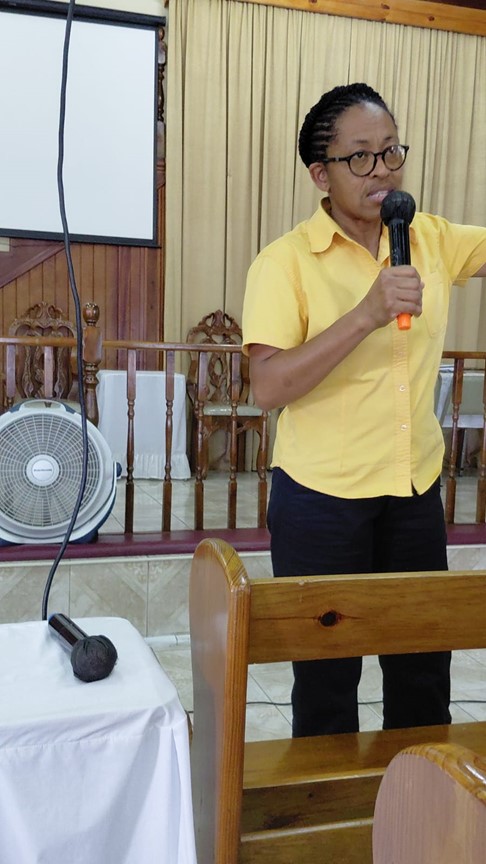
Evangelist Fay Robinson-Tee is trumpeting the call for communities, and parents especially, to fortify their children in faith, as current geopolitical tensions are likely to give birth to famine and mental health challenges.
Evangelist Robinson-Tee is a counselling psychologist who worked as a mental health nurse for nine years at the Bellevue Hospital, the largest public psychiatric institution in the English-speaking Caribbean, and another 15 years in community mental health before transitioning to become an associate counselling psychologist.
From her years of experience, her prescription for helping children to cope with the current global instability is to teach them faith and resilience.
“We [parents] are limited in ourselves, so we have to discuss the realities but point them to somebody who is unlimited in His power, unlimited in His presence and who knows exactly how to comfort them because He knows exactly how they feel. So we have to live as if we’re truly people of faith, and our children will feed on that in order to stand in these times,” she told the Freedom Come Rain newspaper.
“It doesn’t matter what psychological intervention we can bring. Very good, that’s important. But we need to practise our faith in the presence of the children who see a world falling apart,” she said.
She pointed to the fact that a lot of those considered to be Gen Z, and who were born in a primarily digitalised era, are struggling to cope with life.
“They would have seen failures of business. They would have seen job losses on the part of their parents. Some of them might have even dropped out of high school and university because the economies became uncertain when we had COVID. So what we find happening is that there is now a group of people who see life as uncertain. You have among them people who foresee a shortened future. They don’t see any reason to look forward to old age. Just live it up now. Whatever happens, happens. Life is uncertain,” she said.
“So there has to be a grounding. There has to be a grounding in faith in order for us as adults to stand, for the younger adults to stand, and for the children to stand. That’s what’s going to be the ultimate,” she advised.
As geopolitical tensions intensify in the Middle East and other parts of the world, including in the Caribbean, teaching children how to be more resilient is becoming even more crucial.
Globally, governments are accelerating or activating civil emergency preparations, including stockpiling food/water, updating survival guides, and rationing oil and other resources.
According to the United Nations Development Programme (UNDP), the escalation of conflict in the Middle East, particularly due to the Iran-Israel/US tension which started on February 28, is already causing significant job losses, wage reductions, and employment instability across multiple sectors globally and regionally.
The closure of the Strait of Hormuz – through which around 20% of the world’s oil and natural gas flows – has seen fuel costs rise sharply in the past month. Locally, manufacturers are warning of the potential increase in food costs as the price of oil escalates daily. In Cuba, where a US blockade on oil has been imposed, students are primarily attending classes remotely, hospitals are running low on medicines and food is in very short supply. Citizens spend most of their waking moments plunged in darkness.
Evangelist Robinson-Tee says that in times like these, it is not sufficient to just tell children to have faith. Parents she said will need to show children what this looks like. She said the passage of Hurricane Melissa last October is an indication of how children respond to crisis. As one of the persons who offered psychological first aid in western Jamaica following the hurricane’s devastating blow, she saw firsthand its impact on young citizens.
“When we are faced with crises of national or international magnitude, our children do not escape the impact. And because childhood development does not change with changing dynamics in society, [it] doesn’t change with location, because once a human, always a human, the needs will always be the same. And if the needs aren’t met, the spin-offs are likely to be the same, especially where there’s no support to be a kind of cushion. So if we look at what happened during and post-COVID, we look at what happened during and post-Melissa; we can look at what will happen during and post a war,” she said.
Side bar
Teach children “good ole Jamaican” survival skills
Mental health practitioner Fay Robinson-Tee enjoys hearing stories from senior citizens about how they survived World War 2.
The associate counselling physiologist is an evangelist and a pastor’s wife who believes community togetherness is crucial to surviving difficult times.
“Now in World War II, there was no internet, there was no telephone, and aeroplanes were rare,” said said.
They tell her of the days they went without electricity and used a Tilly lamp to navigate the darkness.
“Not the home sweet home lamp with the glass,” she clarified.
“Not at that time in the 1940s. These are persons who would have been born in 1935 or 1936, the ones I spoke with. So they were small children. So the war was from 1939 to 1945. And they spoke about shortages of things like sugar, rice, flour, and oil, as in cooking oil,” she recounted.
Kerosene was in short supply, much like everything else at the time in Jamaica, which was a British colony at the time.
Today, she encourages parents to share these stories of survival with the younger generation.
“We have to teach our children resilient skills. “They may be very brilliant academically, but they need to learn hands-on,” recommended the counselling physiologist who is also a mother.
“You teach them how to hold a machete…let us not move away from that. You can’t pay people to do everything. So our children need to start learning. Learning basic gardening. Every home should have a tool, a set of tools. A machete, a hoe, a fork; even the miniature types, a hammer, your nails, your screwdrivers, your spanners, your pliers, your wire cutters. Every home should be equipped with tools,” she insisted.
With food shortages likely to become a factor as the war intensifies, policymakers and other stakeholders have been encouraging household farming.