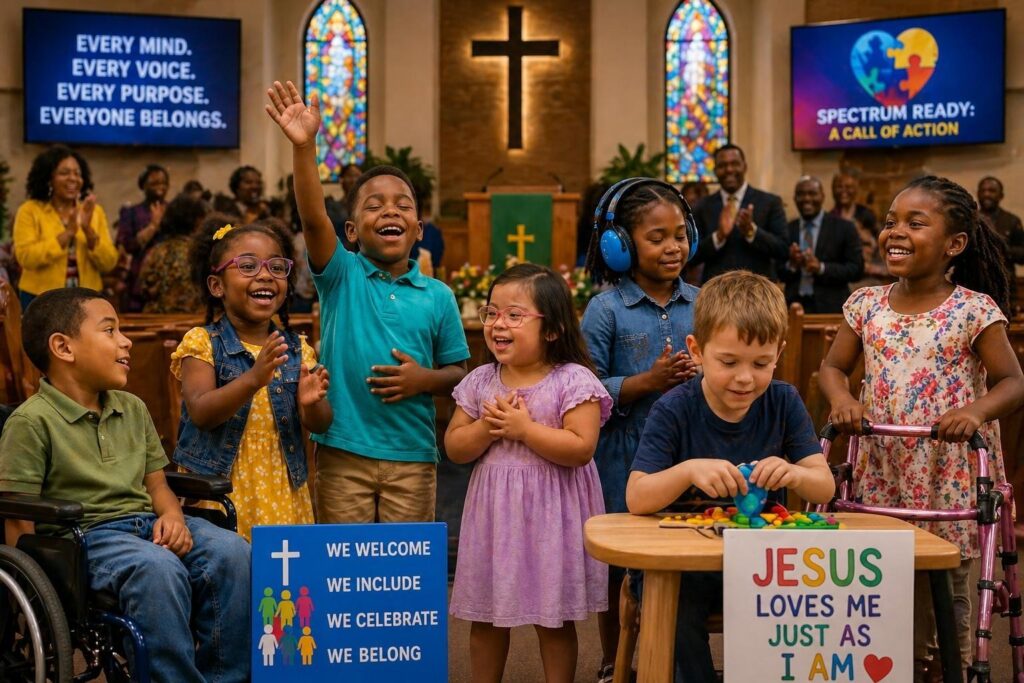
April is Autism Awareness month. The 30 days have gone by quickly and we are thankful for how the Jamaican society is becoming more sensitive to the needs of this community. We still have some matters outstanding and the objective of this article is to spotlight one that concerns the church.
Throughout Jamaica, the Church has long been a source of sanctuary, revival, and restoration. However, at this season, there is a deeper call—one that invites us to not just welcome but also fully include.
Autism Spectrum Disorder (ASD) is not uncommon in our communities; it exists in our families, schools, and, yes, even our churches. The question is not about whether autistic children and adults may enter our churches but whether our churches are prepared to meet them where they are.
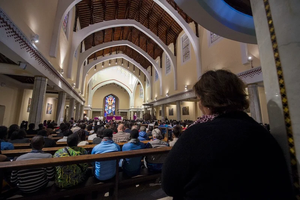
Moving from passive acceptance to deliberate transformation is what it means to be “Spectrum Ready.” It asks churches to consider their surroundings, organizational systems, and customs. Are there peaceful places to relax and regulate? Do our services permit flexibility in terms of movement, expression, and various forms of communication? Open doors are not enough to achieve inclusion; careful adaptation is also necessary.
Inclusion is a Kingdom duty, not a side ministry. This entails educating leaders, instructors, and ushers about neurodiversity. It entails making it possible for people on the spectrum to lead, serve, and fit in as valued members of the Body of Christ, rather than as anomalies.
The pastoral community needs to be prepared to guide families through autism with understanding, empathy, and impartiality. Additionally, evangelism needs to become inclusive. The truth that the Gospel is for everyone must be reflected in our approach. Communication should be easy to understand, straightforward, and accessible to people who have difficulties with both expressive and receptive language, as well as literacy.
A message is effective when it is understandable. Pace, repetition, visual accompaniment, and practical application are all factors in spectrum-ready preaching, which ensures that every listener may connect with Christ’s message.
We must also change the way we approach prayer. Autism should never be the subject of prayers attempting to “cast out” demons just because a child or adult has special needs. That approach is not just theologically careless but also dangerous. Deliverance prayers should be used when there is clear, specific evidence of demonic activity, not as a standard response to neurological anomalies.
Instead, the Church must pray for wholeness and healing in ways that uphold dignity. Cover the individual in prayer for every aspect of their being—the brain for clarity, development, and regulation; the nervous system for calm and balance; the stomach and digestive system—which are frequently associated with sensory and health issues; the blood for strength and vitality; and the entire body for peace and restoration. Pray about emotional stability, communication skills, and a sense of purpose. Pray for families: patience, togetherness, and endurance.
To be rapture-ready means to be ready for the coming of the Lord. To be rapture-ready also carries a mandate which is clear in Mark 16:15, we need to preach salvation to all people, including special needs. Should we only preach salvation and not be prepared to accommodate all people?
We serve an inclusive God who meets each individual at their moment of need. The Church must do the same. The first stage is willingness: a simple “yes” to learning, adjusting, and evolving.
The mandate is clear: equip the Body of Christ to serve everyone. The moment we become spectrum-ready, we grow increasingly Christlike.
Peta-Gaye Forbes-Robinson, MBA, RBT (Non-licensure) is an Autism Advocate. She has always been interested in catering to the needs of persons with disabilities, and has done much work in the field of autism in Jamaica.