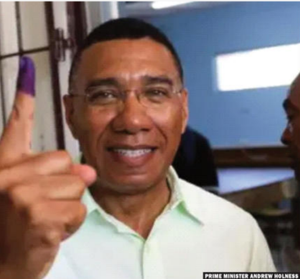
The November 3, 2026, Supreme Court ruling by Justice David Batts that a constitutional motion brought against Prime Minister Holness by People’s National Party (PNP) candidate Paul Buchanan must proceed to a full trial, is the latest in several legal challenges against the country’s leader.
Here is a review of some of Holness’s legal battles with the constitution over the last few years.
- Pre-Signed Senate Resignation Letters
As Opposition leader in 2013, Holness had used pre-signed letters of resignation to oust Dr Christopher Tufton and Arthur Williams from the Senate, replacing them with Ruel Reid and Dr Nigel Clarke. Williams challenged the move. Jamaica’s Constitutional Court On February 6, 2015 declared that Holness had acted unlawfully. The court declared the letters null and void. Holness’s requirement of pre-signed letters was deemed unconstitutional, null, and void, as it undermined the independence of the Senate.
- The NIDS Act
In April 2019, The Constitutional Court struck down the much-touted National Identification and Registration (NIDS) Act. The landmark ruling handed down by Chief Justice Bryan Sykes, Justice Lisa Palmer Hamilton, and Justice David Batts, unanimously declared the NIDS Act as unconstitutional, null and void.
.Opposition Member of Parliament Julian Robinson challenged the 2017 NIDS legislation, arguing it violated citizens’ fundamental rights under the Jamaican Charter of Fundamental Rights and Freedom.
Chief Justice Bryan Sykes delivered the judgment. He ruled that forcing citizens to submit mandatory biometric information violated the constitutional right to privacy across three dimensions: privacy of the person, informational privacy, and privacy of choice.
The Government said NIDS would improve the country’s national security situation and would make it easier for Jamaicans to conduct business.
A significantly amended NIDS Act was passed in the House of Representatives in October 2021.
- UNCONSTITUTIONAL STATES OF EMERGENCY
After months of raising concerns about the States of Emergencies (SOEs) instituted by the Holness administration, the Opposition People’s National Party (PNP) withdrew its initial support in 2018.
The Holness Administration had been using the SOEs as a major crime fighting measure since 2017 and was allowed several extensions by the Parliament. Supreme Court Justice Bertram Morrison ruled in September 2020 that the months-long detention of five men without charge under the SOEs was unconstitutional. Some of the men had been held without charge or bail for up to one year.
Detention orders issued by the minister of national security were also declared unlawful. Justice Morrison ruled that the government had overstepped the bounds of the power of the executive and declared that the use of the orders for the detention of the men for criminal cases without proper review breached the doctrine of separation of powers.
Morrison also ruled in 2020 that, “The situation which led to the detention of the men does not qualify as an emergency or satisfy the situation in sections 20 (2), 20 (5) of the constitution”.
The men were released from police custody when the SOEs ended on August 17, 2020, the day before Nomination Day activities for the September 3 General Election.
The Government appealed the decision, but the Appeal Court also determined that the Government was “bound by the decision” of the Supreme Court and threw out the case in July 2023.
- Director of Public Prosecutions (DPP) Tenure Extension
The Full Court (Justices Sonya Wint Blair, Simone Wolfe Reece, and Tricia Hutchinson Shelly) ruled that the Holness administration acted unconstitutionally by granting the Director of Public Prosecutions, Paula Llewellyn, a second extension of her tenure. The extension was declared null, void, and of no legal effect. After the ruling by the Constitutional Court, the Government announced plans to file an appeal. The Court of Appeal overturned that lower court’s decision in December 2024, and Llewellyn was allowed to return to her duties until reaching age 65 in September 2025.
- Holness versus Integrity Commission
Prime Minister Andrew Holness lost appeals in his legal challenge against the Integrity Commission’s 2024 investigation reports into his financial declarations. Justice Althea Jarrett and the Appeal Court ruled against Holness’s attempts to strike out portions of an affidavit by former Integrity Commission official Greg Christie and blocked efforts to halt the disclosure of certain files.