In Jamaica, where corruption and deception thrive and have been elevated to the highest levels, voter fraud does not seem to be a big deal.
Leading up to the recently held polls, no one raised an alarm when all indications pointed to the fact that Jamaica was all set to run a high-stake election on a questionable voter’s list. After all, an inaccurate voter’s list encourages and facilitates electoral fraud, and we are living in chopper country, where theft, con, and illicit enrichment are acceptable, affirmed, and even celebrated.
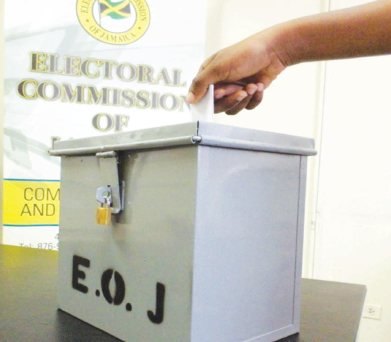
A clean voter’s list is essential to an authentic election process and outcome. The last voter’s list leading up to the September 3 general elections indicated that nearly 2.1 million Jamaicans were registered to vote. That number alone should have raised eyebrows, if not given sight to the blind.
The total Jamaican population, including children, amounts to 2.8 million. Bearing in mind that children under age 18 are not eligible to vote, it means that the entire adult population, including those who are mentally deranged or otherwise incapacitated, would be registered on that last list.
We all knew that this could not be true, as there are many persons who were never enumerated, and many who could not be enumerated for one reason or another. This basic fact begged for a detailed review and cleansing of the voter’s list. Those managing the process should have made it their business to find out who was legitimately registered as against who was not.
Deliberately or otherwise, eyes remained blind, eyebrows levelled, and safe passage was given to a flawed list for September 3. The nation had positioned itself to return to the days of running contentious and deliberately dubious elections.
Without intentional manipulation, numbers hardly lie. In 2002, Jamaica’s population was said to be about 2.6 million. Roughly 1.05 million of the total were children under 18, so only about 1.55 million could legally register to vote. Up to that time, the list was reasonably clean with 1.30 million enumerated.
In 2007, the population was officially reported to be about 2.66 million, with about 1.07 million being children under age 18, leaving 1.59 million voting-age adults.
The voter’s list showed 1.28 million enumerated.
By 2011, the population was estimated at 2.7 million, with about 1.09 million children under 18, leaving 1.61 million adults eligible to vote. The Electoral Commission of Jamaica (ECJ) registered 1.65 million voters.
But by 2016, something changed. The population was said to be 2.73 million with some 1.10 million children under age 18, leaving 1.63 million adults eligible to vote. However, the voter’s list recorded 1.82 million persons enumerated. This is nearly 200,000 more than those eligible to vote.
Things took a turn for the worse in 2020, with the population at 2.8 million and children under age 18 at 1.10 million. There were 1.7 million adults eligible to vote by that count. Yet the voter’s list presented 1.91 million persons as being enumerated. 210,000 names were added beyond the total adult population of the country.
By 2025, the population was recorded to be 2.84 million persons. Of this number, around 1.15 million were said to be children under age 18, leaving 1.69 million eligible adults. But the electoral commission was reporting 2.08 million registered voters. Nearly 400,000 names were added beyond Jamaica’s voting population.
Somewhere since 2016, those tasked with keeping population data or those registering voters got their math wrong. It would seem that more names were included on the voter’s list than actual people living in the country. Perhaps the names of the dead and others who migrated were never removed from the list.
No one knows whether votes were cast in these unaccounted-for names. When questions swirl about the voter’s list, the very process and election outcome are cast in doubt.
Jamaica has lived through a long, turbulent period of bogus voting and rampant electoral fraud. Back then, overvoting in many constituencies was the order of the day.
The voter’s list for elections was padded beyond human comprehension with hundreds of thousands of names of persons who were dead or who did not exist.
The padding of the voter’s list normalised electoral fraud. In those elections, the way was made for wide-scale impersonation and many votes were cast illegitimately.
Electoral fraud shows up as election manipulation. It facilitates vote rigging and could expand to include illegal interference with the process of an election.
Widespread electoral fraud in Jamaica saw to the establishment of political garrisons and the skyrocketing of the murder rate. The security forces were used to enforce the will of their political bosses and impersonations occurred in many constituencies. Aided by the fictitious names, the contests between the two main political parties led to the proliferation of gun violence and gang warfare. Those days are ones this nation should never wish to revisit.
Somewhere leading up to 1980, a group of well-thinking parliamentarians, former prime ministers, and party leaders, Michael Manley and Edward Seaga, made the decision that the fraudulent operation at elections could not continue.
They worked together to establish the Electoral Advisory Committee (EAC), with responsibility to protect the electoral process from the direct control of the Government. It operated from 1979 to November 2006, when the Senate passed the Electoral Commission Act for the creation of the ECJ.
The ECJ was comprised of two commissioners nominated by the Prime Minister, two by the Leader of the Opposition, four commissioners agreed on by both the Prime Minister and Leader of the Opposition, and the Director of Elections appointed unanimously by the eight commissioners.
The ECJ and its predecessor, the EAC, had been meeting with representatives of political parties, civil society, and members of Citizens Action for Free and Fair Elections (CAFFE) after each general and local government election to tweak and ensure continued improvement to the process.
When the Electoral Commission of Jamaica, which replaced the EAC in 2006, presents a flawed voter’s list, it brings back painful memories of the old days of wanton electoral fraud. When the voter’s list is filled with errors, it disenfranchises those who are wrongly placed and opens the channels for manipulation in favour of one party or another.
Inaccurate voters’ lists fuel partisan disputes over the integrity of the elections. Social media is littered with complaints about the September 3 polls. Many Jamaicans believe that the election was marred by high levels of voter fraud and the results must not be trusted.
The ECJ needs to clean up its act very quickly; Jamaica has come too far to return to the wretched old days.