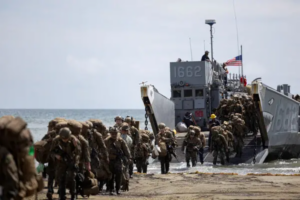
Two strategic earthquakes rocked the region late Friday evening, just hours before the United States Delta Force swooped into Caracas, Venezuela, and snatched President Nicholas Maduro and his wife and delivered them to the US mainland to face criminal charges.
Mexico and St. Lucia were busy trying to calm their citizenry after earthquake shocks when the Maduro news broke. A powerful 6.5 magnitude earthquake and hundreds of aftershocks had struck Mexico, causing damage and killing at least two people. Almost simultaneously, an earthquake with a magnitude of 5.6 jolted St. Lucia and nearby nations. There were no reports of damage or injury.
These shakings may have been coincidental, but while the majority of Caribbean people were busy stoking the dying embers of the New Year’s celebrations, President Trump moved in on Venezuela and captured Maduro.
Trinidad, which had sided with the US, was fast on the draw to declare clean hands, if not pure heart, in the Maduro mystery. Prime Minister Kamla Persad-Bissessar promptly released a statement to the effect that the twin-island republic played no role in the demise of the Venezuelan head of state.
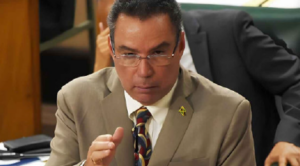
Interestingly, Trump made his move on Maduro a day after Jamaican Prime Minister Andrew Holness ended his stint as the chair of the Caribbean Community (CARICOM), also sparing him any blame in this matter.
Four months before he was to assume the chairmanship of CARICOM, it was clear that Holness was caught between a rock and a hard place, as he skittishly welcomed US Secretary of State Marco Rubio to an official visit to the island.
It is for good reason that CARICOM heads of state play musical chairs with the leadership of the group every six months. This makes it tough for any one country to sell out the region for personal gain. But Holness, a man who sees a political heavyweight of sorts whenever he looks in a mirror, leads an administration with a high perception of corruption.
Under his leadership, CARICOM lost its voice. The regional bloc had very little to say while hell was breaking loose in Haiti and rumblings were rising between the United States and Venezuela. Holness was oddly absent from the limelight when Venezuelan diplomats delivered supplies to Jamaica after Hurricane Melissa. He dodged the anti-CARICOM posturings of the Trinidadian prime minister and waited in the shadows for his term to end.
But days before he stepped away from the CARICOM chairmanship, on December 11, 2025, Prime Minister Holness met in Kingston with a senior delegation from the US Department of Defense. Attendees included Patrick Weaver, Senior Advisor to the Secretary, and Joseph Humire, Acting Assistant Secretary for Homeland Defense and the Western Hemisphere. The discussions focused on deepening the bilateral partnership and strengthening security cooperation.
For months, tensions over the worsening US/Venezuela affair continued to divide the region. Trapped in a mischief of his own making, Holness remained mum. He is a man conflicted and compromised, obeying the orders of the United Nations, answering every call, and bowing tothe United States’ dictates.
For decades, the US’ stance against both Venezuela and Cuba has been a heavy burden that Caribbean nations carry. CARICOM leaders have been holding their peace, while seething against US sanctions and actions.
Cuba has been a major help to the Caribbean through its very generous medical mission, sending hundreds of well-trained doctors and nurses to top-up and support struggling health sectors in nearly every country.
At a time when Caribbean states badly needed fuel at a good cost, Venezuela stepped in with ready-help.
This Maduro development does not sit well with former or current Caribbean leadership or the population at large. And already there are soundings from US quarters that military action against Cuba could be on the horizon.
Caribbean nations are vulnerable to political and economic shifts in larger countries. They struggle with the challenges of socio-economic development, including high levels of corruption, crime and violence, import dependence, food insecurity, persistent inflation, and massive debt.
Seen as an exotic collection of sun-baked countries, the Caribbean’s mainstay has been tourism. Since the plandemic, tourism earnings dipped dangerously in many places. Negative travel advisories have impacted the region in significant ways.
The United States has not provided much help for any of these trials. In fact, efforts were made to tax remittance flows and increase deportation levels.
For eons, Caribbean leaders have been trying to find a mechanism that will get the states working together to cut continued linkages and dependence on larger nations for the good of the populations.
The first Caribbean federation, the West Indies Federation (1958-1962), was a short-lived political union of British Caribbean colonies that collapsed due to internal conflicts, primarily disagreements over power distribution, economic policies, and a strong desire for separate independence, especially from larger islands like Jamaica. Its failure stemmed from competing nationalisms, weak federal structures, and key political leaders’ reluctance to cede power, ultimately leading to member territories pursuing independence individually instead.
Not much has changed in the region since that time.
When CARICOM was formed on August 1, 1973, with the signing of the Treaty of Chaguaramas, the hope was to foster deeper regional integration, economic cooperation, foreign policy coordination, and social development for a stronger collective voice and shared prosperity in the Caribbean.
Through the Caribbean Single Market and Economy (CSME), CARICOM tried to integrate the member states into a unified economic unit. It aimed to pool the region’s resources to improve international competitiveness and standards of living through free movement of goods, human, and natural resources.
Caribbean nations share the good fortune of their location, right at the back door of the United States and at the gateway of Latin America and Canada. Large countries in Europe and in Asia have been seeking to take advantage of markets in the Americas, and partnerships with Caribbean nations are strategic pit stops and warehouses for their goods.
Caribbean countries must determine their own future. There has to be more for these states than being the butler at the back door of the United States or the strategic gateman for enterprising partners, such as the European Union or China.
If CARICOM will not work in the best interests of the 46 million population within the region, it may be time for a new mechanism to be identified to protect the people and the resources, especially oil, natural gas, and precious stone deposits.
As the geo-political dynamics unfold before our very eyes, no Caribbean leader, especially the compromised, should consider himself or herself safe in statehouse walls.
Donald and Delta are not just about Maduro or Cuba; they will strike anywhere it suits them, even in Jamaica House.