

People are drawn like bees to the garden of agro-forester Claudelle Maitland Wilson. It is pretty. Nestled around the vegetable beds and pots brimming with edible plants are trees and shrubs and beautiful bushes of marigolds and flowering vines.
Claudelle started a small farm in 2017 with just bananas and plantains before branching off into cash crops, papayas, and pineapples. In one year, everything was expanding, including her family. Pregnant with her first child in 2018, she decided to reduce the farm to a garden that she could manage. It was still a lot of work, but she said that, given her technical training, she could no longer afford to continue eating vegetables she knew were loaded with chemicals and synthetic fertilisers.
The agroforester was quick to inform that, although she has an agriculture background, there is so much to learn when you actually decide to take on a dedicated garden yourself. She had to research the best ways to grow the foods she and her family love, and in spite of her demanding schedule, she still tries to keep up with her favourite gardeners and homesteaders on YouTube.
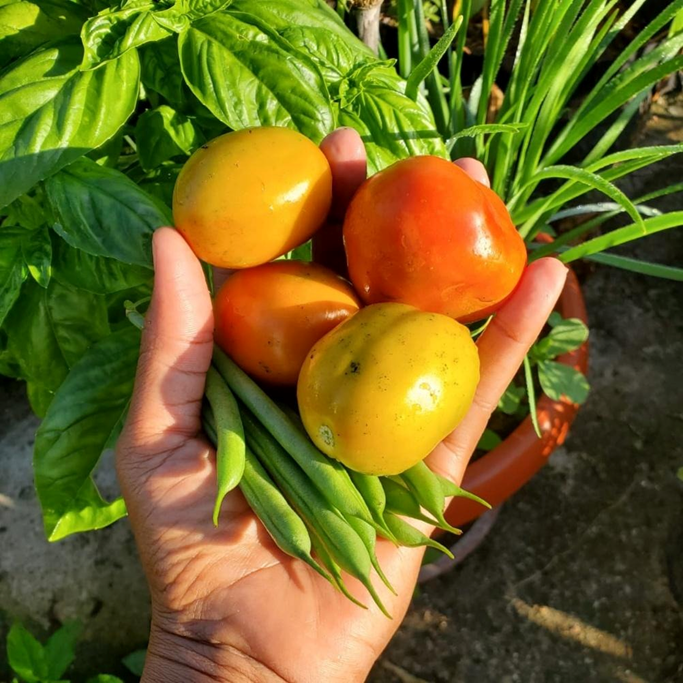
Mostly a container gardener, she has three in-ground garden beds, plus various sizes of containers with cabbage, callaloo, tomato, cucumber, turmeric, ginger, pak choy, curled kale, carrot, string beans, okra, Irish potato, sweet potato, sweet corn, beetroot, turnip, lemon, June plum, dragon fruit, Jerusalem peas and garlic chives. Malabar spinach and cowpeas are trellised on the fence along a wall.
“In planting this way,” she explained, “I get a lot of food out of a small area, and when the plants get bigger, their foliage shades the soil to minimise weeding and evaporation from the soil.”
PESTICIDES AND FERTILISERS
Claudelle admitted that when she first started out, she used chemical fertilisers. They certainly boosted the plants and made them grow foliage quickly, but they were always susceptible to pests. But when she switched to making her own compost, she noticed a difference with the quality of the produce and that they were more resilient to pest attacks. She started learning about the soil food web and the importance of feeding the soil, rather than the plants, as her goal was to cultivate healthy, nutrient-dense crops. And over time, she even figured how to make her own homemade spray for pests if they exploded beyond her integrated pest-control system.
Claudelle is on a campaign to encourage as many persons as she can to grow their own food. “It increases food security,” she explained. “We may not be able to afford to buy spinach and kale from the supermarket or market, for example, but we surely can afford to grow them at home to feed the family nutritious meals. A pack of local seeds costs less than a pound of any vegetable you can buy.”
GARDENING TIPS
Claudelle leaves these tips with us at Freedom Come Rain:
- If you are afraid to go big, start where you are. Recycle a 5L bottle and plant one vegetable in it. Gather lessons learnt from that trial and use them to improve on the other containers you will eventually add to your garden.
- Always check for pests on the growing tips and the underside of the leaves in your garden. Also, plant flowers in the garden to attract beneficial insects and natural predators that will prey on the pests. For example, dill plants attract ladybugs especially when they are allowed to go to seed, and ladybugs have a voracious appetite for aphids.
- Crush eggshells and sprinkle them around the garden. The sharp edges deter snails and slugs when they crawl over them.
- You can also sprinkle baking soda around your pots to prevent snails and slugs from crawling into the containers. Try not to sprinkle this in the soil, as it can affect the pH and make your plants not grow well.
- Another method is to set slug/snail traps using beer. Put some beer in a cup and dig a hole deep enough to accommodate the cup in the ground so that the rim is in line with the soil surface. The smell will attract snails and slugs, causing them to fall into the beer…
Claudelle Maitland Wilson has been saved for the past five years and is an agroforester at the Forestry Department in Jamaica. She works directly with farmers to help them deliberately use trees to improve their farm output and improve their local economic development.