Jamaica has rewritten winter-sport history.
Nearly four decades after the country’s improbable debut at the 1988 Winter Olympics captured the world’s imagination and inspired the classic film Cool Runnings, a new generation of Jamaican bobsleigh athletes has delivered the nation’s first-ever gold medal at an international bobsleigh competition.
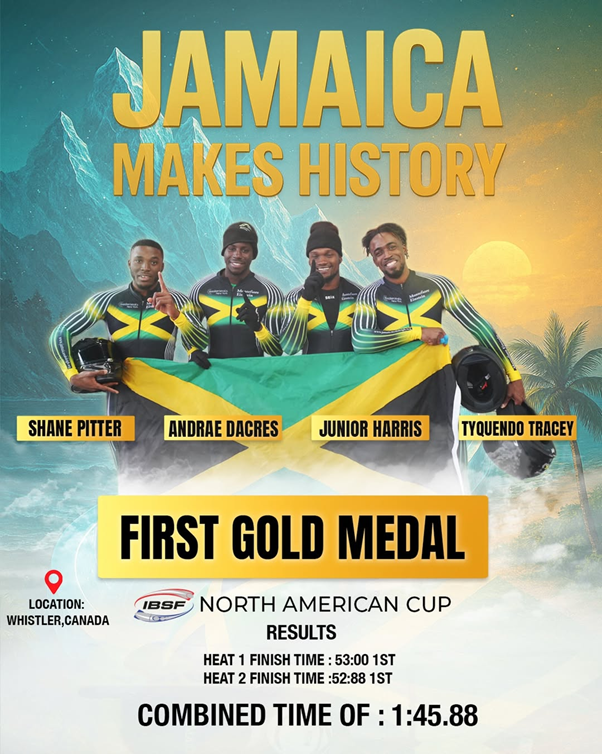
The quartet of Shane Pitter, Tyquendo Tracey, Andrae Dacres, and Junior Harris stunned traditional powerhouses at the International Bobsleigh and Skeleton Federation (IBSF) North American Cup in Whistler, British Columbia, racing to victory in a blistering 1:45.88 on one of the fastest tracks in the world.
Their win didn’t just turn heads; it shattered expectations, challenged stereotypes, and signalled a seismic shift in Jamaica’s winter-sport ambitions.
A Victory That Echoes Beyond the Ice
“When I crossed the line and saw first place, I couldn’t believe it,” said Pitter, still emotional days after the accomplishment. “This is why we train so hard. This is what we work for. This is what we reap.”
For Harris, the achievement struck even deeper. “It just feels real good because our families are proud and the whole island of Jamaica is proud,” he said. “We’re a tropical island. Nobody expects us to win gold in a winter sport. But we always believe.”
Their belief carried added meaning this month, arriving just weeks after Jamaica was devastated by a deadly hurricane. The team says they hope the gold medal offers the country something to cheer for as a reminder of resilience in a moment when hope is needed most.
Speed Over Size: A Jamaican Blueprint
Jamaica’s success wasn’t accidental. It was engineered. For nearly a decade, the Jamaica Bobsleigh and Skeleton Federation (JBSF), led by president Nelson Stokes, has reimagined its recruitment strategy, shifting away from the stereotypical bobsleigh focus on bulky, heavyweight athletes and turning instead to the island’s most abundant resource: elite sprinters.
Driver Pitter and brakemen Tracey, Dacres, and Harris are all former sprinters, including Tracey, a two-time national 100 m champion, and Dacres, an Intercollegiate 100 m gold medallist.
“We’ve always known Jamaica is one of the fastest populations on the planet,” Stokes explained. “We may not be the biggest or thickest, but we might be the fastest. The key is to find sprinters who are fast and powerful enough to move the sled.”
In Whistler, the strategy paid off as Jamaica logged the fastest start times in every heat, outrunning heavier teams, including the Koreans, who had doubted Jamaica’s strength earlier in the season.
“We beat them,” Stokes said. “Speed and strength come in many forms. Our guys proved that.”
Jamaica’s rise is also supported by a growing international partnership. The team recently benefited from a Korean-funded training camp and now works with former Canadian head coach and Olympic medallist Todd Hays, described as “one of the best in bobsleigh” by Canadian athlete Chris Ashley. Also watching proudly from the sidelines in Whistler was legendary coach Pat Brown, the same man who guided Jamaica’s original 1988 team.
“To see them win… it’s fantastic,” Brown said. “This is a win for the sport. Before 1988, nobody even knew what bobsled was. And now Jamaica is winning races.”
Bobsleigh 2034: A Serious Mission
The JBSF believes this breakthrough is only the beginning. The federation has set its sights on consistent podium finishes by 2034, and the Whistler gold represents a major step in that long-term project. Young sprinters continue to be recruited, most recently national standout Ashanti Moore, who will join the women’s programme in January. Still, the transition is gruelling. “Bobsleigh is cold, the sled is heavy, and your shoulders hurt,” Stokes admitted. “It’s a hard sport but the rewards are real ‘
A New Chapter for Jamaica’s Winter Dreams
With qualifying for the 2026 Milan Winter Olympics underway, the team believes their historic weekend in Canada is the spark that will carry them even further.
“This is just the start,” Harris said. “Trust me, you will see even greater things from us.”
Jamaica’s first international gold in bobsleigh is more than a medal. It is a reminder of what Jamaican sport does best: defy odds, inspire nations, and prove again that greatness can come from anywhere.