Whenever senior American diplomats interact with the leadership of any nation, it is always about securing United States interests and advancing American critical geo-political agendas.
When former State Secretary Hillary Clinton landed in Jamaica unannounced in 2010, she was on a mission to expedite the extradition of Christopher ‘Dudus’ Coke and deliver a stern warning to then Prime Minister Bruce Golding.
Former State Secretary Antony Blinken visited Jamaica in May 2024 to participate in Haiti-related “Kingston Talks”. At that time the US was determined to keep Haitians fleeing their strife-torn country off American shores.
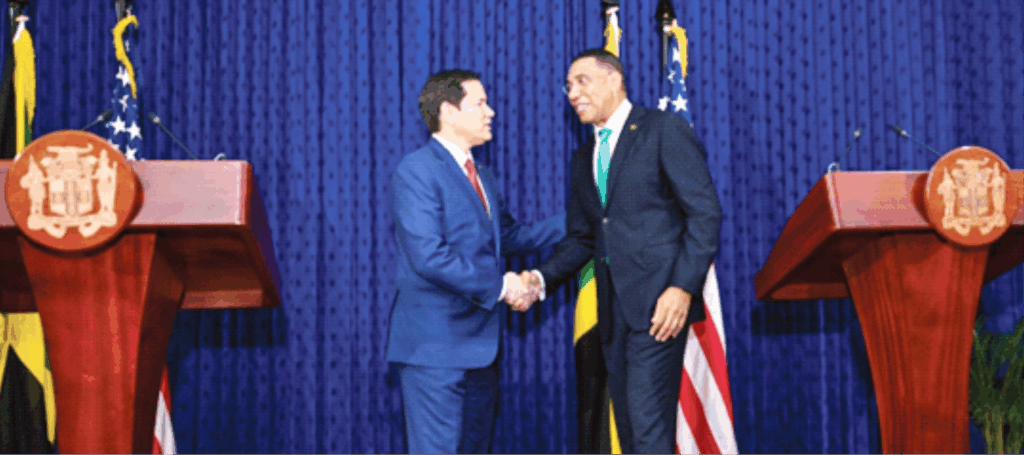
So, in the aftermath of United States Secretary of State Senator Marco Rubio’s visit to Jamaica in March this year, major developments were expected. The prophetic word was that feathers would be ruffled and wings would be clipped.
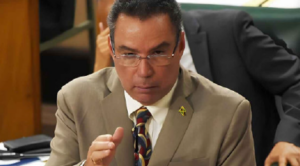
The US sees Prime Minister Andrew Holness as an ally, a man willing to stand against his Caricom neighbours, Cuba, Venezuela, Haiti and possibly China, if instructed.
In March 2019, when Donald Trump sought to divide and conquer the Caribbean by inviting selected CARICOM leaders to meet with him at Mar-a-Lago during his first term as president, Holness was among them.
In March 2022, Holness travelled to Washington to meet with former Vice President Kamala Harris where she presented him with US$30 million to help with security and youth empowerment programmes.
While Secretary of State Senator Marco Rubio was landing at the Norman Manley International Airport earlier this year, the Department of State, which he heads, was making its final edits to the condemnatory International Narcotics Control Strategy Report (INCSR) that exposes the criminal shenanigans of global governments and publicly shame them into behaving better. Jamaica was on that list.
In that edition of the report, the US State Department thrashed Jamaica’s failure to combat money laundering and political corruption. It said the island’s effort to contain the scourge is being undermined by severe resource constraints and systemic corruption.
The report identified organised criminal networks – some with ties to influential Jamaicans and key players in the real estate and used car sectors – as the primary drivers of money laundering in the country.
So, even as Secretary Rubio was publicly naming Prime Minister Holness as an ally, the agency he heads was broadcasting the fact that political and public corruption was propelling illicit activities in Jamaica.
Public reports that Holness was under investigations by the Integrity Commission for illicit enrichment must have been the elephant in the room during his private discussions with the State Secretary.
Interestingly, while Rubio was meeting with Holness and his elephant, the state department was reporting that the illicit proceeds which fuel Jamaica’s underground economy are largely generated from narcotics and weapons trafficking, cybercrime, financial fraud schemes, extortion, and corruption.
The State Department also flagged significant cross-border criminal activity, including the trafficking of small arms and drugs between Jamaica, the United States, Central America, Europe, and Haiti, as a major source of illegal wealth.
The United States has always been a mastermind at manipulation and allusion, so not a single word of this damning report was mentioned when Rubio and Holness faced media microphones after their secret talks.
But at the height of Holness’ proudest political moment, just hours before he was to be sworn in for the fourth time as Prime Minister, the “Determination on Major Drug Transit or Major Illicit Drug Producing Countries for Fiscal Year 2026” list was released. Again Jamaica is included.
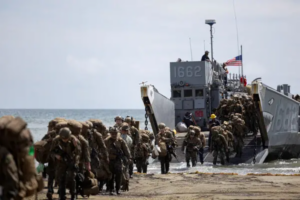
The Trump administration has deliberately increased the U.S. military presence in the southern Caribbean, targeting Venezuela. Using its power and might, the U.S. military killed more than a dozen people and sank boats from Venezuela. They justified the assault under the fight against narcotics.
Venezuelan President Nicolas Maduro said the incidents between his country and the United States are an “aggression” by the U.S., not tensions between the two countries, and that there is no communication between the governments.
Earlier this year, the US also asserted its power over the Caribbean when President Donald Trump leveled threats of visa revocation and the imposition of tariffs against Caribbean nations who harboured the Cuba medical mission.
Trump knows that visa revocation is like Kryptonite to political supermen and superwomen as well as the commercial and upper classes of Caribbean societies. The threat of losing their US visa has always forced third world strong men, politicians and their friends to readily comply with US demands, even if it meant compromising the healthcare and energy supply of their own country.
Both Cuba and Venezuela are seen as geo-political hindrances for the United States, but major sources of help for the Caribbean, infusing critical support to struggling regional economies, easing the healthcare and energy burdens for their over 15 million population spread.
The super generous Cuban medical mission and the purchase of crude oil from Venezuela have been lifesaving undertakings sustaining cash-strapped CARICOM nations against global economic shocks.
Trump wants CARICOM’s full loyalty and compliance at any cost. The heavy footprints of China in the region is deeply troubling for the US, and worse, Venezuelan umbilical links to Russia cannot be facilitated in its backyard. Unlike Cuba, Venezuela is oil-rich and can fend for itself. Furthermore, US sanctions, threats and attacks on Venezuela could activate Russian and Chinese response. That is a risk the Trump administration is willing to take.
Trump’s mouthpiece, Marco Rubio, on his Caribbean visit in March, was tasked to lay out the president’s regional agenda exactly as it was given to him. High importance was placed on rubbing out the footprints of China in Jamaica and other Caribbean states. China has invested billions in developing road networks, ports, housing solutions, tourism and other entrepreneurial activities in nearly every town in the region.
After Rubio met with Holness, he was scheduled to have bi-lateral engagements with leaders from Barbados, Trinidad and Tobago, and Haiti during his two-day stay in the region. Visits to Guyana and Suriname were also planned.
Jamaica and other CARICOM states had to choose between their visas or the Cuban health care missionaries. The majority bade the missionaries goodbye. Caribbean states must now consider their position on Venezuela and ultimately their relationship with China. Guyana, which is new to the oil-wealth ranks and Trinidad with sizeable deposits of tar and crude, have already taken a side. Barbados and St Vincent are putting up some resistance.
Jamaica, an easy target for the United States, will continue to be featured on the lists of nations where corruption, crime and narco trafficking thrive. Feathers have been ruffled and plucked and wings will be clipped. Keep your eyes on Holness’ elephant.