According to the “Determination on Major Drug Transit or Major Illicit Drug Producing Countries for Fiscal Year 2026”, Jamaica, the Bahamas, Belize and Haiti are considered major illicit drug-producing countries.
A “media note” of the document was posted on the US Department of State website on September 15, the day before Andrew Holness was to be sworn in for the fourth time as the country’s Prime Minister. The Trump administration described Holness as an ally earlier this year. According to Mauricio Claver-Carone, Trump’s envoy for Latin America and the Caribbean, Holness “has been a great ally”.
Trump explained that countries are added to the list under the Foreign Assistance Act (FAA) of 1961 because of “the combination of geographic, commercial, and economic factors that allow drugs or precursor chemicals to be transited or produced, even if a government has engaged in robust and diligent narcotics control and law enforcement measures”.
Former FBI Special Agent and Attorney Wilfred Rattigan expressed his views on the matter with the Freedom Come Rain newspaper on Tuesday.
“This should not come as a surprise, considering the number of drug seizures/finds that occurred in Jamaica and its territorial waters over the past few years. Additionally, it wasn’t long ago that the Biden administration classified Jamaica as a major drug transshipment point,” he said.
The US government noted that Venezuela was one of five countries that have failed demonstrably during the previous 12 months to both adhere to their obligations under international counter-narcotics agreements and to take the measures required by the FAA. He told Congress that transnational organised crime’s trafficking of fentanyl and other deadly illicit drugs into the US has created a national emergency, including a public health crisis in the US that remains the leading cause of death for Americans ages 18 to 44.
“This remains unacceptable, and my administration is deploying every aspect of American power and unprecedented resources to defeat this threat to our nation,” noted Trump, who said he intends to use the full range of law enforcement and military resources at his disposal to fight drug dealers.
This has been the basis of the US attack on Venezuela in recent weeks. On September 2, the US launched the first of two attacks on what the Trump administration said was a drug-carrying speedboat from Venezuela, killing 11. Then on Monday, three more persons were killed when the US military targeted a boat allegedly carrying drugs from the South American country.
“The strike occurred while these confirmed narco-terrorists from Venezuela were in international waters transporting illegal narcotics (A DEADLY WEAPON POISONING AMERICANS!) headed to the U.S.,” Trump said in a Truth Social post announcing the strike. “These extremely violent drug trafficking cartels POSE A THREAT to U.S. National Security, Foreign Policy, and vital U.S. Interests.”
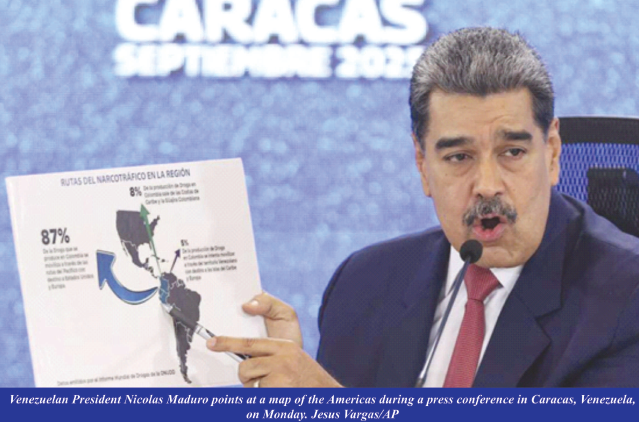
Venezuelan president Nicolás Maduro has vowed to retaliate and has refuted allegations that the socialist-leaning country has been trafficking drugs. He has accused the Trump administration of using drug trafficking accusations as an excuse for a military operation.
Maduro described the attack as “a military attack on civilians who were not at war and were not militarily threatening any country”.
The Venezuelan leader said the ultimate goal of the US was for “a regime change for oil” rather than a crackdown on drug cartels.
Despite concerns from human rights groups, Trump issued a warning on Tuesday, September 16, that signalled things are just heating up.He said he has deployed more U.S. forces to the Caribbean to take on drug traffickers directly and aggressively. This raises the risk of a direct clash between the two countries.
The geopolitical tension increased following announcement that China’s People’s Liberation Army Navy (PLAN) is sending a ship to the region. Although it’s not a warship, Beijing’s presence on America’s doorstep at this time has drawn the attention of US news media. China, a strong ally of Venezuela, has sharply criticised the US military deployment in the South American country. On Monday, September 15, Chinese Foreign Ministry spokesperson Lin Jian stated that the US actions violate international law and infringe on the sovereignty and legitimate rights of other countries.