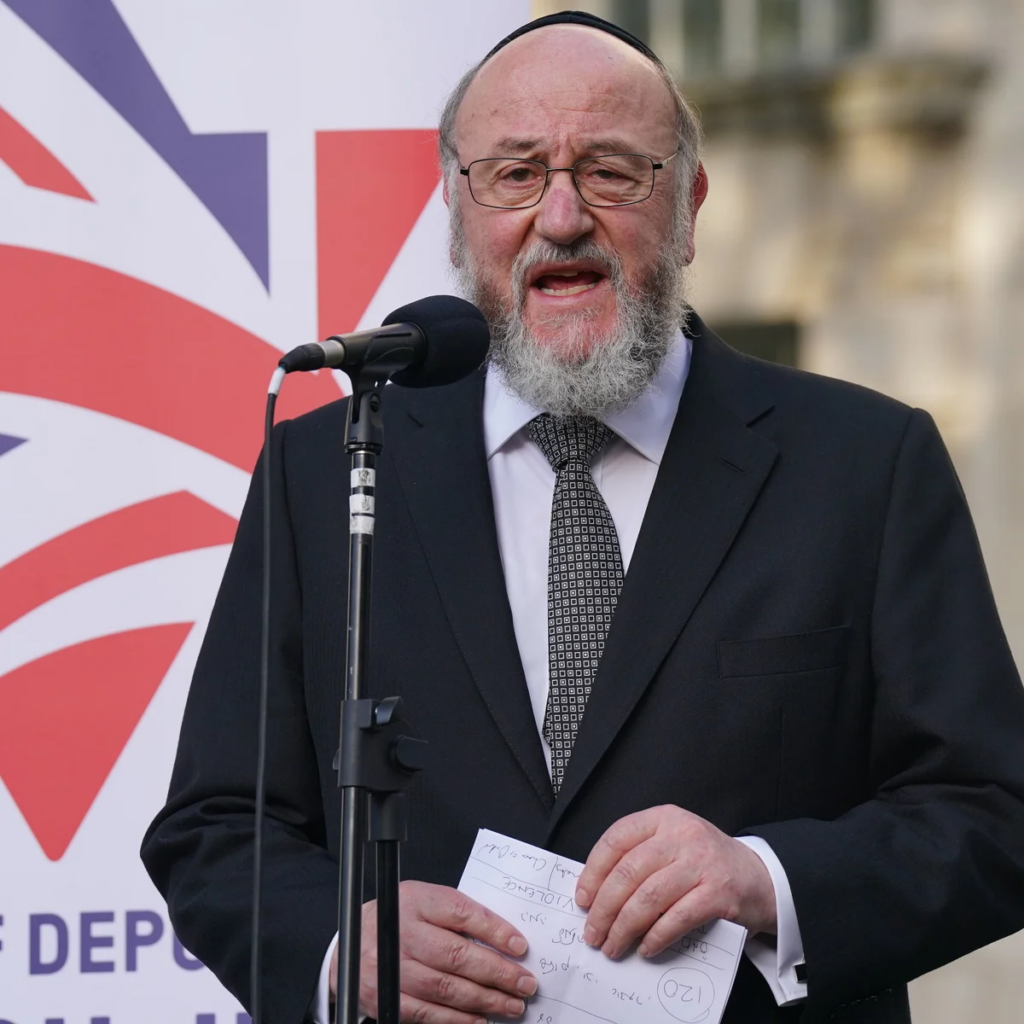
Britain’s Chief Rabbi, Sir Ephraim Mirvis, recently condemned the decision by the Church of England’s legislative body to encourage churches across England to engage with a controversial document that accuses Israel of waging a “genocidal war on Gaza”.
He described this new development as a “sad day for Jewish-Christian relations”, further criticizing General Synod, the Church’s governing parliament. This statement follows their decisive vote to “hear” the text, titled Kairos II: A Moment of Truth: Faith in a Time of Genocide. The document, authored by a group of Palestinian Christians, characterizes the State of Israel as a “colonial enterprise” built upon racism and ideologies of religious superiority.
The diplomatic and religious row erupted during the Church’s multi-day General Synod assembly in York, England recently, where members across all three houses, notably bishops, clergy, and laity, voted in support of a motion promoting solidarity with Palestinian Christians and recommending formal church-wide engagement with the text. The final voting tallies revealed institutional support, with a record of 25 among bishops, 115 among clergy, and 113 among laity in favour. It is noted that there were also dozens of recorded abstentions across all three chambers.
In a sharply worded public statement released shortly after the resolution passed, Chief Rabbi Mirvis called the Church’s decision “shameful.”
“This is a document full of falsehood, which openly rejects dialogue, uses extreme rhetoric to challenge the very existence of Israel, and objects to existing peace agreements in the region,” Mirvis stated. He warned that despite posing as a route to mutual understanding, the text “functions as an egregious barrier to it, reducing one of the world’s most complex conflicts to a single, warped narrative, which can only harm the cause of peace.”
According to an article published by the Jewish Chronicle, the Board of Deputies of British Jews, the primary representative organization for Anglo-Jewry, resonated with these concerns and had heavily lobbied Synod delegates ahead of the debate. Phil Rosenberg, the president of the Board, cautioned that the “falsehoods and distortions” within Kairos II effectively erase Jewish identity and historical experience. Rosenberg characterized the Church’s recommendation as a “prescription for more division” rather than a meaningful answer to the ongoing Middle East conflict.
In contrast, advocates of the motion insisted that the vote was not an endorsement of the document’s entire political framework but an act of essential pastoral compassion. The motion was introduced by Venerable Stewart Fyfe, the Archdeacon of West Cumberland, who represented the Diocese of Carlisle.
Archdeacon Fyfe defended the initiative, pointing out that the language of the original motion had been explicitly amended and softened from “receiving” the document to simply “hearing” it. He denied that the Synod was validating every claim made in Kairos II, emphasizing that the overall goal was to demonstrate concern for the “lived experience” of suffering Christians in the Holy Land. Fyfe further noted that the text represents a desperate “cry from the heart” from a community facing severe displacement and trauma.
The final approved motion calls upon the Church of England to stand in solidarity with Palestinian Christians, grieve the loss of both Israeli and Palestinian lives, and explicitly reject antisemitism and anti-Muslim hostility. It also calls on the Church to acknowledge with repentance its historical contribution to antisemitism.
Despite these balancing clauses, some critics argued that validating a text filled with provocative rhetoric can damage domestic interfaith harmony. The fallout highlights growing structural strains between British Jewish leadership and the established Church, with Jewish organizations expressing concerns that elevating such texts risks fracturing decades of diligently built interfaith trust.
While senior leadership within the Church of England has maintained that dialogue with the Jewish community remains a priority, this vote has undoubtedly cast a long shadow over future uniting initiatives
As the resolution begins its implementation across local dioceses, British religious commentators note that the long-term impact on communal unity remains uncertain. Both sides now face the challenging task of navigating pastoral obligations abroad while attempting to repair frayed partnerships at home.