The privileged classes in Jamaica were stupefied in 1865, when formerly enslaved people in Morant Bay, St Thomas, openly challenged the colonial government in a heroic pushback against severe poverty, lack of voting rights, and a corrupt judicial system that favoured wealthy white planters after emancipation.
The colonists and their friends moved quickly to quell the uprising using state terrorism and court-sanctioned murder. Two years after the bloodbath in the eastern parish, the Jamaica Constabulary Force was established to keep the descendants of enslaved people cowed in their quarters.
The force was deliberately designed on the militarised model of the Royal Irish Constabulary and purposefully configured with a distinct racial and class divide. The officer corps were reserved for white British/Irish recruits, and the rank-and-file constables were drawn from the local Black/indigenous population.
This structural division intentionally utilised local Black policemen under white leadership to maintain control over the masses, protect British plantation interests, and suppress any future thought of an uprising.
Today, video clips with police personnel brutalising and abusing ordinary citizens who pose no immediate threat regularly reinforce the fact that the JCF, which was born in blood and shaped in inequity, remains true to its 160-year-old roots.
The Constabulary may declare itself a force for good, but fierce men, attired in combat gear, parading with guns and eager to kill any member of the masses, paint a different picture.
Two years ago, Jamaican Prime Minister and Minister of Defence Dr Andrew Holness sent a stern message to criminal elements within society. “You will either meet a judge or your maker”. The message was delivered when passions were high and the nation was in shock after a brutal mass shooting in Cherry Tree Lane, Clarendon.
Since then, Holness has repeatedly used the phrase to emphasise a zero-tolerance policy on organised crime. During a New Social Housing Programme ceremony in St James, Holness again directed these exact words toward individuals being deported from the United States with criminal intentions.
Not to be left out of the action, the Minister of National Security, Dr. Horace Chang, bolstered the rhetoric by standing firmly in defence of the police amid public concern over rising fatal shootings. Chang repeatedly pushed back against critics, declaring that officers are highly professional and operate strictly under their mandate to “protect and serve”. However, widely circulated video clips that raise serious questions about fatal shooting incidents suggest that the police are certainly not about protecting or serving the people.
Criminals in the constabulary and on the streets do not miss the very serious implication buried in Holness’s argument. The options during special operations are courthouse or morgue and the police are empowered to make that ultimate choice.
Holness and Chang should know that the Jamaican Constitution guarantees every Jamaican the fundamental rights to life, personal liberty, and security of the person. It also establishes that any police use of force must be strictly necessary, proportionate, and lawful. But a police force built on 1865 realities reads these laws differently.
By physical appearance alone, both Holness and Chang rank among the privileged classes of 1865. Their tone replicates the sentiments of the colonial government. Neither would ever be counted among the descendants of the emancipated black population, who remain the primary targets of the police mandate.
This is not the case with Minister of Government and Member of Parliament Desmond McKenzie. Last Tuesday, Desmond, a man who has the bearings of the emancipated majority, found himself in entanglements with the police in West Kingston during an unrest event.
The minister was summoned by constituents from the comfort of his air-conditioned offices to present himself in his West Kingston constituency where the latest controversial police operation was underway.
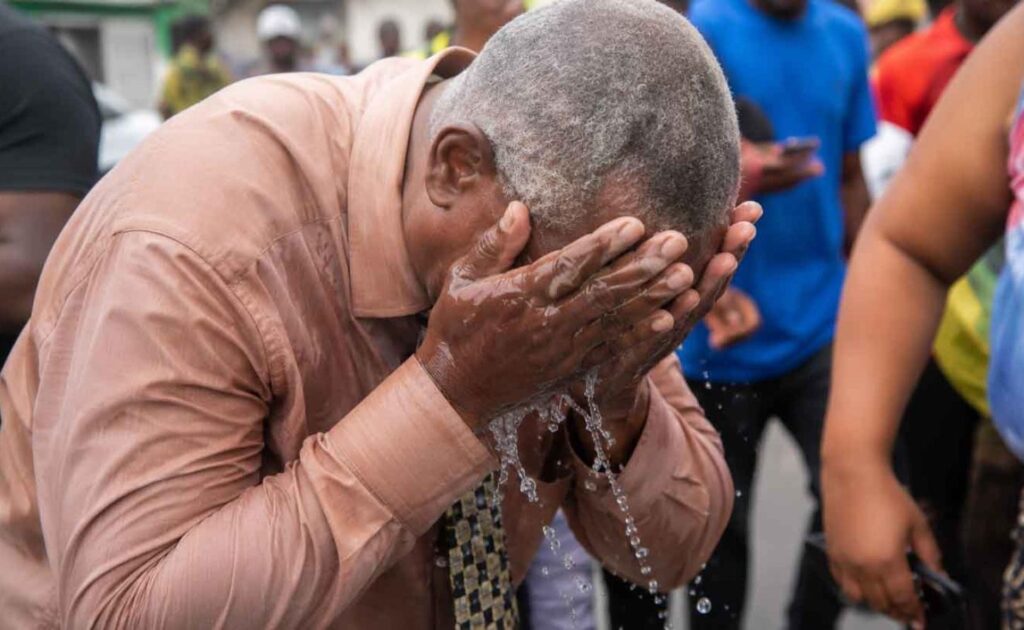
Desmond, a mature man who is always well attired, is not the first politician to attend West Kingston amid controversy over the way the police were conducting their business, but he is the first to be pepper-sprayed while doing so.
The late Edward Seaga, a man of a different colour, was a member of Parliament for West Kingston in 2001 when he ventured into the constituency during an intense, hours-long standoff between the police and heavily armed gunmen. Seaga was not pepper-sprayed when he spoke firmly with the police and offered them safe passage out of the area in the middle of the gun battle.
McKenzie’s rank as a senior minister of government and his elevated position as Member of Parliament could not camouflage the fact that his appearance easily made him another victim of the system that was set against ordinary Jamaicans more than 160 years ago.
If nothing else, the pepper-spraying of McKenzie should bring home the fact that lawlessness among lawmen is systemic. Many in the ranks are indoctrinated into disparaging and disregarding their own people and treating ordinary Jamaicans as unworthy of basic respect or even life.
For too long, the nefarious roots of the JCF have been honed and nurtured, especially by politicians who defend the wickedness leveled against the citizens. The McKenzie episode demonstrates that neither the governed nor the governor, who looks like the ordinary folk, is guaranteed protection from police abuse.
Jamaica urgently needs a principled and righteous police service, protecting and assuring all its citizens, regardless of class, colour or creed. The seeds of wickedness planted in 1865 have matured and are bearing fruit. They must be uprooted and the stumps removed once and for all.