Already hit by drought brought on by the El Nino phenomenon, wildfires and praedial larceny, Jamaican farmers will now have to brace for increased production cost as a significant increase in the price of fertilizer is expected in the coming weeks.
This is according to the International Chamber of Commerce (ICC), which has warned that the disruption in the Strait of Hormuz is squeezing the world’s fertilizer supply. If this continues, farmers will grow less, and food could cost more.
Fertilizer shipments through the strait essentially collapsed after the Iran conflict began in February. The ICC Secretary-General John Denton says available fertilizer capacity has fallen nearly 40%, taking roughly 2.7 million tons off the market. Countries like China have also implemented export limit, making access to supplies more challenging.
Higher prices and sourcing issues are expected to continue into 2027 and beyond.
The Middle East supply roughly 30 per cent to 35 per cent of the world’s urea, which is a nitrogen fertiliser. Nitrogen fertilizer takes a lot of natural gas, and so when energy prices jump, fertilizer prices do likewise.
“Nitrogen (urea) prices climbed above $850 per metric ton in April, up 80 percent since February and the highest level since April 2022. The surge was driven by major export disruptions following the closure of the Strait of Hormuz, a key shipping route for fertilizer exports from the Middle East, which accounts for nearly one-quarter of global urea exports. Supply pressures have intensified due to production outages across the region. The Islamic Republic of Iran halted ammonia production amid the conflict, while Qatar suspended production of urea, ammonia, and sulfur after damage to key facilities. India has also reduced urea and ammonia output because of lower LNG supplies,” the World Bank reported.
The ICC has warned that if the crisis in the Strait of Hormuz continues, grain prices could increase by as much as 80 per cent.
Consumers are being warned to expect a further increase in the cost of cereals, bread and flour.
“World wheat prices increased by 6.3 percent from August, reaching their highest level since August 2023, although daily quotations eased towards the end of the month. The rise was largely associated with logistical constraints in the Black Sea region, which prompted importers to shift towards alternative origins,” the Food and Agriculture Organization of the United Nations (FAO) noted.
The increase in prices on the global market has hit local manufacturers hard. Chief Executive Officer of manufacturing giant, Seprod Group, Richard Pandohie told the Freedom Come Rain Newspaper that efforts are being made to provide more affordable products .
“The war is creating a situation, and what you used to get out of the Middle East, you have to divert [and] you have to find other places. Let’s take China and Asia. Shipping costs have gone up again. It’s over $10,000, $13,000 U.S. dollars a container, where it was $2,500 six months ago, seven months ago. And you constantly have to be shifting your supply chain to find other locations to kind of mitigate against the costs. I mean, look at the oil price and the fuel price,” he explained.
“I imagine a lot of the companies out there are just constantly, constantly, you know, trying to navigate the rising cost dynamics out there to kind of make sure that the product is in a position where people can actually afford to buy it,” said Pandohie.
Agriculture, Fisheries and Mining Minister, Floyd Green, stated during a post-Sectoral Debate press conference in May that the full effect of the rising fertiliser and oil price is not yet being felt locally. He said the government was taking a multifaceted approach to providing support to farmers.
“We’ve seen increases in nitrogen prices, we’ve seen increases in potassium prices, and that makes an impact. So, while we have access, there has been increased prices. And we have seen some of that being passed on to our farmers. In fact, we would have met with our major fertiliser supplier, and they have cauterised that as much as possible,” he stated at the time.
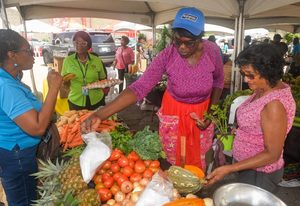
Consumers have been expressing concern about the high cost of produce at the markets. Lettuce for example was at $1600 per lbs, while carrots went up to $400 per lbs last week.
A recent United Nations-backed report highlighted that 55% of Jamaicans face moderate or severe food insecurity, with 28% experiencing severe conditions such as skipping meals or going hungry.