Jamaica delivered a statement performance at the 2026 World Athletics Relays in Gaborone, Botswana, not merely through medals, but through execution, cohesion, and a long-overdue correction of past shortcomings.
At the centre of the resurgence was a historic breakthrough in the mixed 4x100m relay, where Jamaica rewrote the record books. The quartet of Ackeem Blake, Tina Clayton, Kadrian Goldson and Tia Clayton stormed to gold in a world record 39.62 seconds, lowering the mark they had set in the heats.
The performance was significant beyond the stopwatch. Jamaica became the first nation to break the 40-second barrier in the event, highlighting a level of technical execution and team balance that had often eluded them in previous global outings. If that race set the tone; the women’s 4x100m final delivered one of the defining moments of the championships.
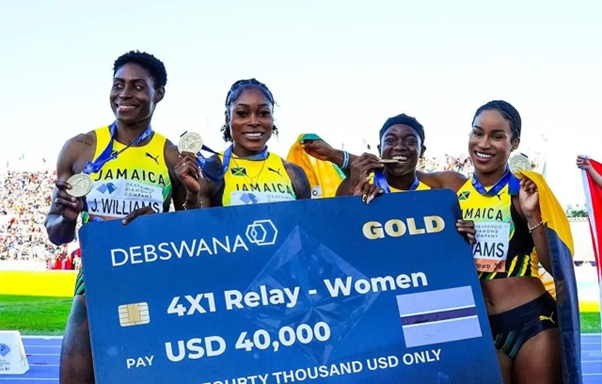
Five-time Olympic champion Elaine Thompson-Herah marked her return to international relay competition in emphatic fashion, anchoring Jamaica to gold in 42.00 seconds. She was joined by Shelly-Ann Fraser-Pryce, Shericka Jackson and Natasha Morrison, forming a formidable lineup that blended experience with proven championship pedigree.
Her victory carried added weight. The 33-year-old had spent nearly two years battling an Achilles injury that ruled her out of the Paris Olympics, making her presence and performance in Botswana a defining moment in Jamaica’s campaign.
“I’m satisfied to walk away with the gold,” Thompson-Herah said following the race, describing her return as both a personal and competitive milestone.
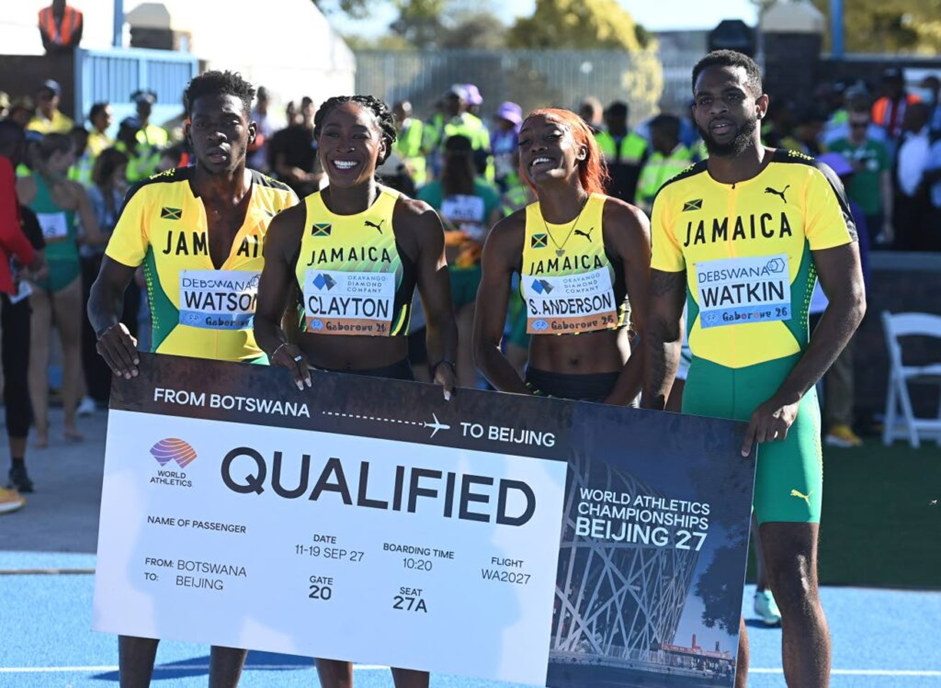
Jamaica’s success extended into the mixed 4x400m relay, where the team of Deandre Watkin, Shana Kaye Anderson, Antonio Watson and Rushell Clayton secured silver in a national record 3:08.24. They also secured qualification to the World Athletics Championships in 2027 to be hosted in Beijing, China.
The performance reinforced a broader theme across the championships: improved structure, cleaner baton exchanges, and a more deliberate approach to relay composition.
Even amid the successes, there were reminders that Jamaica’s relay programme remains a work in progress. The men’s 4x100m team, for instance, rebounded from an earlier setback to secure qualification for the 2027 World Championships. The quartet of Rohan Watson, Odaine McPherson, Adrian Kerr, and Rasheed Foster clocked 38.14 seconds to win their repechage heat ahead of Belgium and Nigeria, showing composure under pressure when it mattered most.
There was, however, disappointment in the men’s 4x400m relay. The team of Assinie Wilson, Jeremy Bembridge, Jevaughn Powell, and Raheem Hayles finished fourth in 3:01.63, narrowly missing automatic qualification for the World Championships in Beijing.
Collectively, the results represent a sharp turnaround from the previous edition of the World Relays, where Jamaica’s campaign was hindered by inconsistent team selection, limited preparation, and technical errors that jeopardised qualification for major championships.
In Gaborone, those issues were not entirely absent, but they were significantly reduced. Instead, Jamaica displayed a more refined relay model: defined personnel pools, improved baton discipline, and greater continuity across rounds. The success of the mixed 4x100m team, in particular, underscored the benefits of repetition and chemistry, key ingredients long emphasised by the world’s leading relay nations.
For Jamaica, a country whose sprinting legacy has traditionally been built on individual brilliance, Botswana signalled something more complete: a programme beginning to align its raw speed with the structure required for sustained relay success.
With two gold medals and a silver secured, it marks a significant improvement on last year’s return of one silver and one bronze. Those numbers tell part of the story. The larger narrative is the one of progress. After a period defined by inconsistency and missed opportunities, Jamaica’s performance in Botswana suggests the nation’s relay programme is firmly moving in the right direction.