
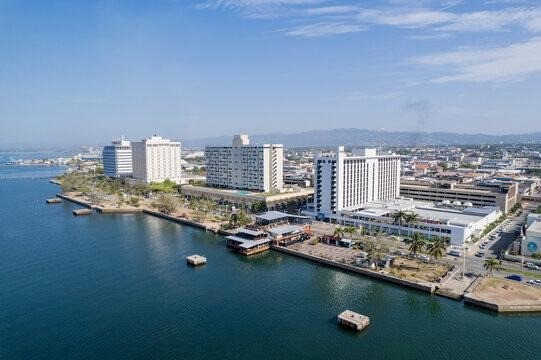
Like a bolt of lightning flashing across dark, stormy skies, news broke last week that a lease agreement fetching a whopping J$115 million (US$726,000) was signed for two floors of the prestigious Digicel building in downtown Kingston to house the National Reconstruction and Resilience Authority (NaRRA).
The horrific news hit like gale-force winds just a week ahead of the first anniversary of Hurricane Melissa making landfall in Jamaica. Unbridled anger raged and tempers flared; Jamaicans were livid about Melissa’s recovery money being flung away with wild abandon.
The national reconstruction agency sees itself as extravagantly high-end, belonging in the upscale neighbourhood of the telecommunications giant’s Digicel Regional headquarters and IBEX, the global business process outsourcing (BPO) and contact centre provider.
Digicel, a big money earner, generated US$1.8 billion in annual revenue across its 25 regional markets for the 12 months ending March 2026.
IBEX had leased multiple floors within the Digicel building to serve as its Caribbean and Latin American headquarters. For its June 2026 financial year, the global business processing company recorded US$147.17 million in revenue from its nearshore operations (which include Jamaica, Nicaragua, and Honduras) and US$327.27 million from its offshore operations (Philippines, Pakistan, and India), out of a total consolidated revenue of US$644.08 million.
While IBEX previously operated out of the waterfront site, the company transitioned and expanded its operations into newer and more cost-effective campus facilities in Greater Portmore, St Catherine.
NaRRA, which places itself around the multi-billion dollar round table, does not earn a single dime. In fact, it is designed to spend massive amounts of loan and grant fundings which taxpayers, their children and grand-children will have to repay if the Lord tarries. This agency is projected to spend $30 billion JMD of the government’s capital budget for the 2026/2027 fiscal year. Additionally, the national budget includes an initial $2 billion JMD provision specifically to support the establishment and initial operation of the authority.
For an agency earning nil income, news of the egregious waste of public resources on rent was beyond vexing. Too many families are still barely surviving under tarpaulins, schools and public structures remain in a state of disrepair, and the island is locked in the death spiral of drought and ensuing famine. Jamaica’s Bread Basket has been kicked over as agricultural operations right across the farming belt are upended.
The infuriating news was too much for a country that had barely survived two major storms in two years and a series of minor earthquakes in very short order. The ravages of Melissa are still fresh and undressed.
Of 688 schools that were originally reported damaged across the island, more than 100 remained in varying states of disrepair as of September 2026. Approximately 146,000 buildings suffered major to severe structural damage across the island, with over 116,000 structures classified by Prime Minister Andrew Holness as having “severe or catastrophic damage”. Many of these are still in disrepair.
Jamaicans know that there are many unused government properties that are languishing like white elephants ready to be retrofitted for the likes of NaRRA. The Trelawny Multi-Purpose Stadium and the Montego Bay Conference centre are fit for serious consideration, as they would place the reconstruction agency directly into the region that suffered the greatest devastation.
Jamaica is in a very fragile state, and NARRA was expected to restore it, not break it further by throwing large chunks of the recovery money into wagga-wagga rent.
And, if that were not enough, the basic annual salary for NaRRA’s CEO, Major General Antony Anderson, is J$40 million (or US$251,139.16) in addition to perks. This is US$22,000 more than the full emoluments for the head of the United States Federal Emergency Management Agency (FEMA), who makes an annual salary of US$228,000 (or J$36.3 million) and carries far greater responsibilities.
The salary that the NaRRA CEO is raking in suggests that the government is unaware that the average pay of a top-level professional or executive in Jamaica ranges from JMD 6 million to JMD 15.5 million per year.
The government must also be unaware that public sector doctors, nurses, teachers and security workers are restive as their demand for a liveable wage has been rejected and that many are being forced to migrate in order to earn enough to take care of their families.
They must also be ignorant of the fact that Jamaican consumers are faced with astronomical food costs and that more than half of Jamaica’s population (55.1%) experienced moderate or severe food insecurity in recent years. According to the United Nations Food and Agriculture Organization (FAO) Regional Overview of Food Security and Nutrition, Jamaicans are facing significant challenges regarding the cost of living and dietary quality across the island. Thousands of families in Jamaica are unable to afford one balanced meal per day.
When he announced the historic US$6.7 billion coordinated international financing package for hurricane recovery last year, Prime Minister Andrew Holness could hardly contain himself. He stated that the multi-year investment framework would be used to rebuild stronger, secure Jamaica’s future, and drive long-term resilience.
No one anticipated that securing Jamaica’s future would include paying a totally unnecessary ‘multi-massive’ lease for NaRRA and bang-belly salary to its CEO.
By now, the Jamaican people should face the fact that the politicians and their friends and associates are not for them. They are busy engorging themselves on huge salaries, nepotism and other forms of corruption.
The Jamaican government lacks conscience and compassion and is now demonstrating that it also lacks basic common sense. Talk is cheap, and government banter is free gratuitous and insincere. This nation is perched on a perilous brink and tipping fast towards total annihilation.