More than a year after the release of the prophetic warning that the United States government would ruffle feathers and clip wings in Jamaica, citizens have been forced to watch from the sidelines as the country’s leaders consent to dictates delivered from Washington.
The latest instruction to Jamaica is for the island to host foreign deportees as part of a Third-Country Nationals (TCN) agreement with the Donald Trump administration.
Although National Security Minister Dr Horace Chang insists that the deal with the US to host these deportees is a strictly voluntary arrangement, from all appearances, Jamaica had no choice in the matter.
The US Senate Foreign Relations Committee in its Minority Report published in February 2026 noted the following.
“Third country deportation agreements have become a central feature of U.S. bilateral relations, involving cash payments, political concessions and coercion, without transparency about the full extent of what the United States is giving in return or the pressures it is exerting.”
Third Country Deportation Watch, which monitors the human cost of the programme, noted that, “Third country nationals remain murky, often bound up in pressure and incentives from the Trump administration, as well as broader bilateral geopolitical and financial interests. At the time that many of these agreements were signed and implemented, the Trump administration imposed or threatened third countries with visa bans, deportation of their own nationals, tariffs, and other trade barriers…”
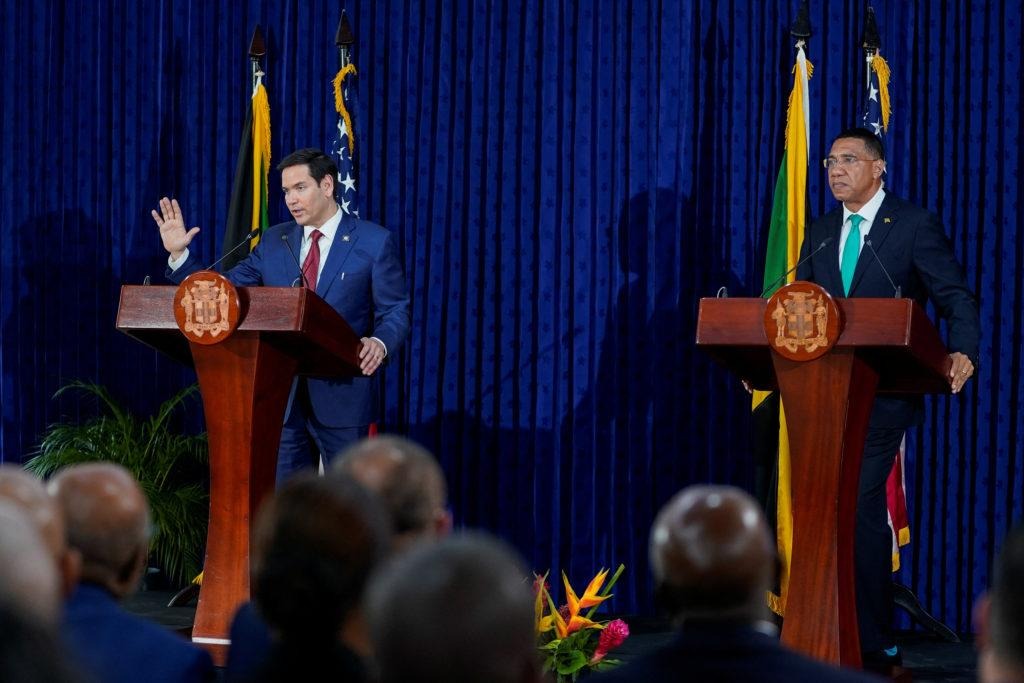
The prophetic warning regarding the US’s growing influence over regional governments came following bilateral discussions between U.S. Secretary of State Marco Rubio and Jamaican Prime Minister Andrew Holness in March 2025. Following the meeting, there were changes to the Cuban Medical Mission which gradually resulted in the ending of the 50-year cooperation programme that was of tremendous benefit to the Jamaican public.
“With this action, the Government of Jamaica yields to the pressures of the Government of the United States, which is not concerned about the health needs of the Caribbean brothers,” Cuba’s Ministry of Foreign Affairs reportedly stated in a social media post from the embassy in Jamaica.
Antigua and Barbuda were among several countries in the region that had signed third-country arrangements with the United States to accept non-nationals from the US under the TCN agreement. Prime Minister Gaston Browne confirmed the agreement.
“We signed an agreement which gives us (the government) the authority, not that we accept whomever, and that the United States will provide intelligence,” he said in January, while noting that his country’s position emphasized that the approach reflects cooperation without compromising sovereignty or national security.
Today, Browne and the US government are at loggerheads regarding the number of deportees to be sent to Antigua and Barbuda. While the government wants no more than 10 per year, the US is insisting on 10 per month.
Browne insists there is no way the federation can take in significant amounts of deportees from the US without compromising local security and placing the government under severe pressure from the public.
“At one point I was told that they had asked us to accept as many as 120 individuals and there was no guaranteed assistance, no guaranteed due diligence. And I said to them that that is totally unacceptable,” he said.
Dr Chang said on Tuesday that the country has signed a memorandum of understanding with the U.S. Department of Homeland Security to accept up to 25 people from countries other than Jamaica every two weeks. He said the persons transferred in the arrangement will be facilitated through a structured process to transit through Jamaica to a third territory, including return to their home countries. Dr Chang said the deportees will not be placed in detention, though details of where they would be housed have not been stated.
Apart from accepting deportees, the US has issued a number of demands to regional governments, including Jamaica. Washington has been pressuring some countries to allow the US military to set up military radars, and other facilities on their home soil. The list of demands for Jamaica continue to grow.
Jamaica’s To Do List
1. End Cuban Medical Mission
2. End any residual oil dependence with Venezuela
3. Accept Non-Jamaican deportees
4. Review and reduce China’s influence
5. Welcome the Aircraft Carrier
6. Await further instructions
Caribbean countries with Third-Country Nationals (TCN) agreement with the US
St. Kitts and Nevis: Signed a bilateral Memorandum of Understanding (MOU) with the U.S. in early 2026 to accept non-violent and non-sexual offender third-country nationals.
Dominica: Formalized an agreement in March 2026 to facilitate the transfer of certain third-country asylum seekers.
Antigua and Barbuda: Signed a non-binding understanding with the U.S. capping acceptances at 10 non-criminal individuals, though the agreement remains non-operational.
Dominican Republic: Signed a non-binding agreement to temporarily hold a limited number of non-criminal third-country nationals, explicitly excluding Haitians.
Guyana: Engaged in advanced negotiations regarding a U.S.-backed framework to accept skilled migrants to address labour.