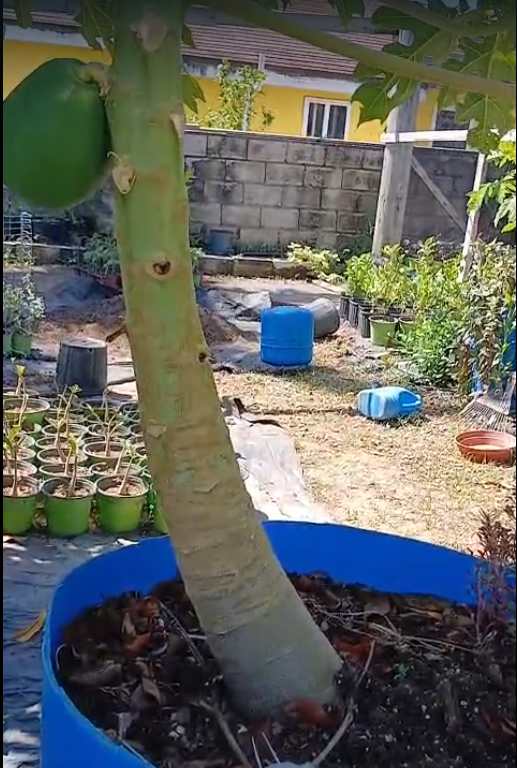
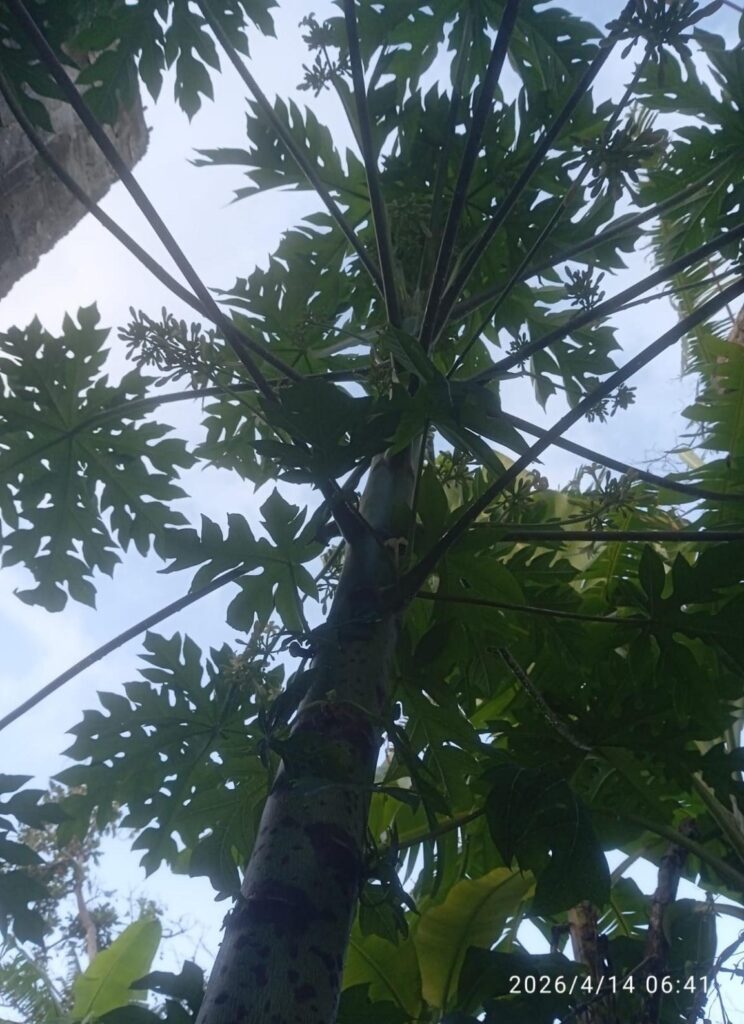
I don’t have much land, but I love fruit trees, so, up to October 28, 2025, I had a Julie mango, an apple tree, a breadfruit tree, and some bananas. As a matter of fact, my yard in Montego Bay is so small I could step from my roof onto the breadfruit tree and pick apples and mangoes from the veranda.
Then came Hurricane Melissa on October 28 and almost all my fruit trees were destroyed. Melissa shredded the breadfruit tree and broke 90% of the mango. The apple survived because the house shielded it, but the bananas? They were pureed by the howling, screaming, twisting winds.
One Wednesday, after visiting the Tarrant Baptist Church (it was November 26), I was gifted a box of fruit seedlings which included some sweetsop, peanut butter, and one papaya—that was about two feet high. My husband replanted it. However, I wasn’t happy with the spot. It was too close to the neighbour’s fence, and I worried it might get damaged since the fencing gave our neighbours access to our yard.
Further, the tree was looking very lean rather than standing straight, but Husband said he had chosen to plant it where he did because he thought it was the best location. I did not debate.
Months later, that same papaya had grown huge. It was no longer on its side but stood more upright. It was exciting to see it pushing out blossom after blossom. When I sent a picture to Sister MD (who had given me the seedlings), she was surprised because she too had received some papaya trees shortly after she gave me mine, and they were in no way as large in comparison. My neighbour also had an older papaya tree, but similar was that situation…no blossoms at all.
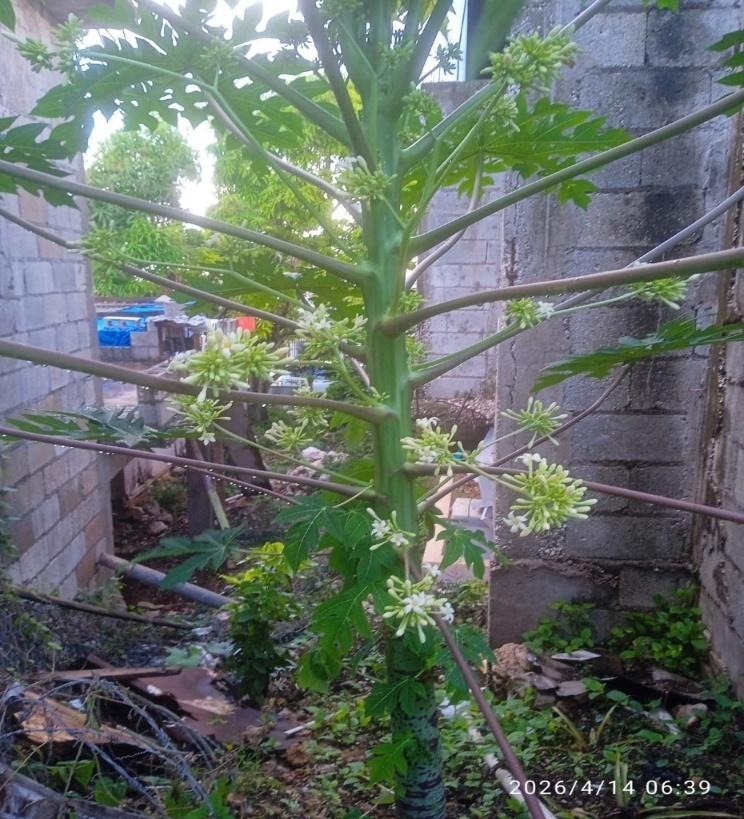
Talking with my husband, I later learned that he had accidentally stepped on our tree when planting it, and that was why it had been tilted for quite a while.
Could this accident have been the reason the tree had grown so rapidly?
We looked it up online and discovered that this is actually a farming technique that gives the same results as one that’s called “the slashing method”. Let’s start with the latter.
After papaya trees start growing, maybe four feet or more, some farmers use a knife to split a section of the trunk (like a foot long) into four pieces. Then they place a stone in the middle of the cut to keep the segments apart. This technique makes the tree pull nutrients as if it were four trees, so it grows bigger and bears more fruit. Other farmers simply lean the tree so that it grows more horizontally than vertically. This renders the same result.
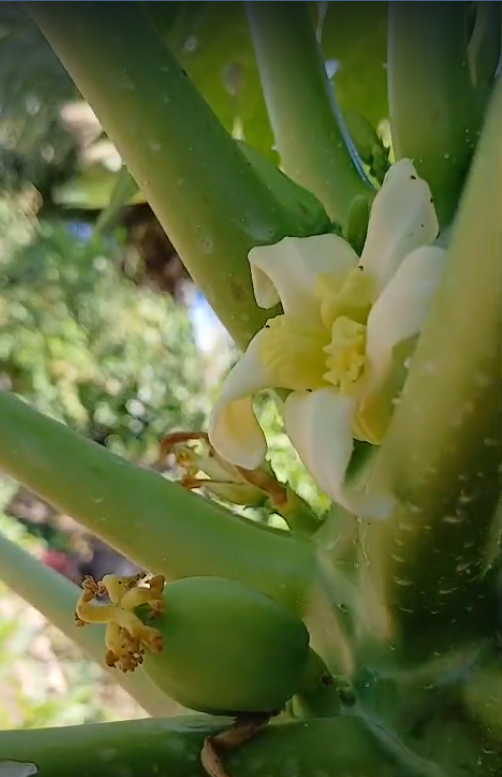
Incredible! An accident had opened our eyes to something new. I told my mother, and she’s going to try it, too.
Update: We were encouraged to share pics of our papaya tree with FC Rain agronomist Linton Neil, who shed some light on our profusely blossoming tree. In a video, he showed us his tree, which was bearing both fruit and flowers. It was very painful to hear him explain that what we had was a male papaya tree, and it would never produce fruit.
God does not contradict himself: the same law that governs sexual reproduction in human nature is the same that rules in mother nature! Blossom, the male papaya tree may blossom, but bear fruit — it will never; it simply was not created with the procreative code to do so.
At first, it was a very hard pill for me to swallow, but when the Holy Spirit presented the truth from this perspective and reminded me how many things I had learned from this experience, I felt renewed hope to try and plant again.